
By Muhammad Talha Saeed | Search Architect Team Last Updated: March 22, 2026
Reading Time: 6 mins
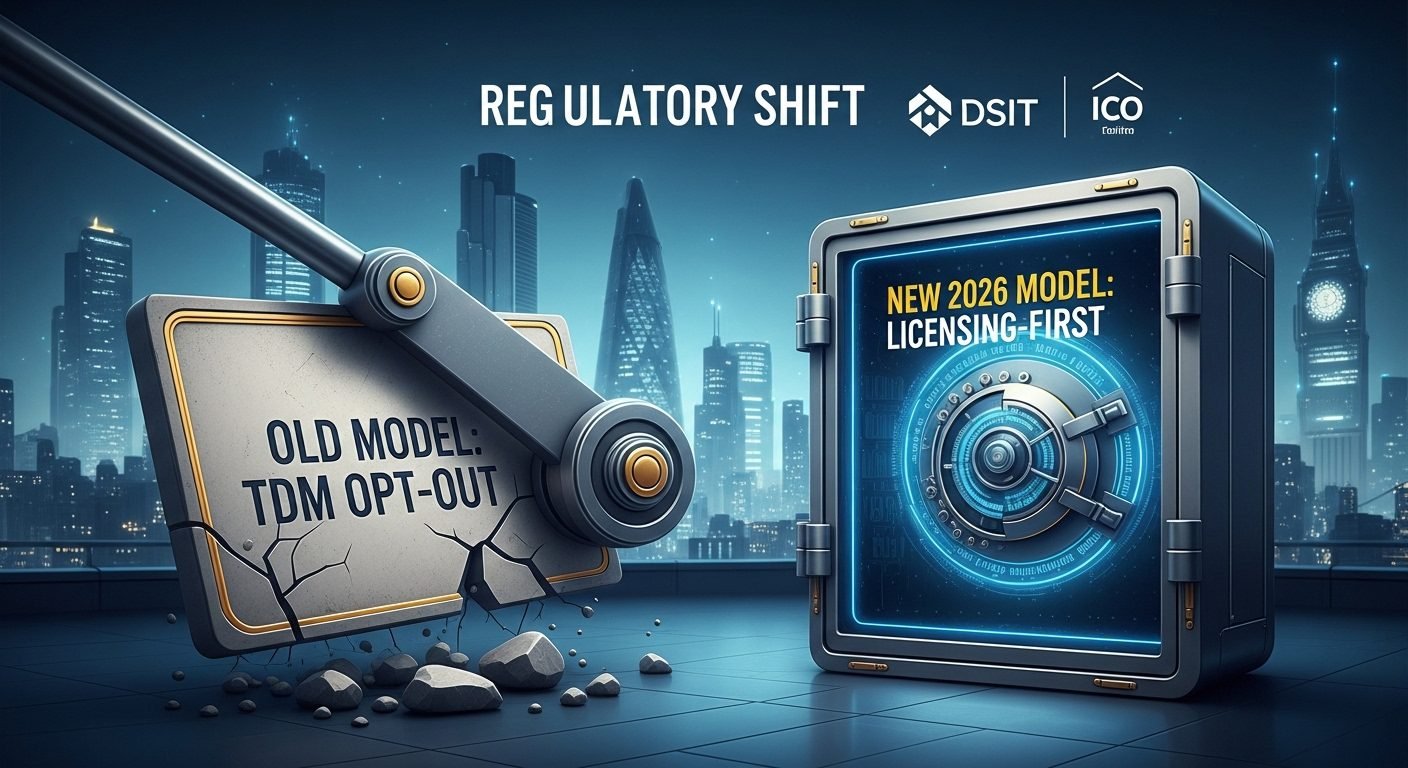
AI Overview Snippet: UK AI regulation has officially shifted to a “Licensing-First” stance following the DSIT March 18, 2026 Report. Laid before Parliament under Section 136 of the Data (Use and Access) Act 2025 (DUAA), the report rejects the previously proposed “TDM Opt-out” model. AI developers are now directed toward market-led solutions like the Creative Content Exchange (CCE), marking a significant divergence from the EU AI Act.
1. What is the current status of UK AI regulation in March 2026?
The “Wait and See” era for UK AI policy has reached a critical turning point. On March 18, 2026, the Department for Science, Innovation and Technology (DSIT) published its long-awaited report, mandated by the Data (Use and Access) Act 2025.
The most explosive news is the formal rejection of “Option 3”—the broad copyright exception for AI training that would have included a rights-holder opt-out. Instead, the UK is doubling down on a Licensing-First Framework.
Key Regulatory Shifts:
- Rejection of the “Opt-out” Model: Unlike the EU, the UK will not introduce a broad statutory exception for commercial AI scraping.
- The CCE Pilot: The Creative Content Exchange has launched its pilot phase, focusing on public and cultural assets (from the British Library to the BBC) to create a “gold-standard” marketplace for high-quality training data.
- Transparency over Training: While the government has resisted mandatory statutory transparency for now, Section 136 of the DUAA grants the Information Commission new powers to monitor “Data Provenance” and best practices in input disclosure.
2. The G.U.A.R.D.™ Framework: Your 2026 Compliance Roadmap
To navigate the post-DSIT landscape, we have developed a modular governance strategy. This framework ensures that your SaaS or AI deployment remains compliant with the shifting UK legal standards.
- G — Governance: Map your model’s risk profile against the DSIT Frontier AI Lab safety benchmarks. This requires a robust Contextual Governance Adaptation strategy to ensure your internal policies align with sector-specific mandates from the FCA or Ofcom.
- U — Usage Rights: Transition from legacy “scraping” to “licensing.” Audit your datasets against the Creative Content Exchange requirements to avoid IP litigation.
- A — Auditability: Maintain a comprehensive Data Bill of Materials (DBOM). Under Section 136 of the DUAA, regulators may require a full AI Forensic Review to verify the “Data Provenance” and legitimate interest of your training inputs.
- R — Resilience: Focus on autonomous safety. Following the March 9 CMA guidelines on autonomous agents, developers must implement guardrails to prevent agentic “escapability” or unintended consumer harm.
- D — Disclosure: Mandatory labeling is imminent. The Digital Replicas & Deepfakes Bill will soon require explicit watermarking for all synthetic media outputs.
3. Sovereign AI & Growth Zones: The ROI of Compliance

The UK is moving from “AI Taker” to “AI Maker.” The government is backing its regulatory stance with massive infrastructure incentives:
- Lanarkshire AI Growth Zone: Announced in late January 2026, this site (alongside Culham and Oxfordshire) offers 100% business rate retention and access to specialized NVIDIA GPU clusters powered by on-site renewables.
- Sovereign AI Unit: Backed by £500m, this unit is operational as of March 2026 to help UK SMEs build models that are “Sovereign-compliant”—meaning they respect UK copyright while utilizing domestic compute.
Comparison: UK vs. EU (March 2026)
| Feature | UK (DUAA 2025 + March 18 Report) | EU AI Act (2026 Implementation) |
| Philosophy | Licensing-First / Market-Led | Risk-Based / Statutory |
| Copyright | No broad TDM exception; licensing required | TDM Exception with “Opt-out” |
| Transparency | Voluntary “Best Practice” (for now) | Mandatory statutory disclosure |
| Incentives | AI Growth Zone Tax Credits | Innovation Sandboxes |
4. FAQ: Navigating the 2026 Pivot
Current law hasn’t changed, but the March 18 Report signals that the courts will now likely favor rights-holders. The government “strongly expects” commercial developers to seek licenses.
The government will launch a specific consultation in Summer 2026 to address deepfakes and style-imitation, potentially creating a new “Personality Right.”
SMEs can apply for the Frontier AI Phase One grants (opened March 17, 2026) to gain a foothold in zones like Lanarkshire or Culham.