
By Muhammad Talha Saeed
AI Quick Summary:
SaaS UX design uitop methodology is a logic-first framework designed to reduce B2B churn (up to 60%) and accelerate Time-to-Value (TTV). Key pillars include component-driven design systems, progressive disclosure, and daily delivery feedback loops to scale software ROI in 2026.
What Is SaaS UX Design?
SaaS UX design is the process of improving user interfaces and workflows in cloud-based software to increase efficiency, usability, and retention.
Unlike B2C products, SaaS product design platforms are built for execution—not exploration. Users rely on them to complete tasks quickly, manage data accurately, and maintain workflow continuity.
The Uitop framework approaches SaaS UX through four key mechanisms:
- Logic-first information architecture
- Progressive disclosure to reduce cognitive load
- Component-driven design systems for scalability
- Continuous feedback loops for rapid iteration
Key Outcomes
When applied correctly, these principles can lead to:
- 20–60% reduction in churn
- Up to 80% faster onboarding
- Increased lifetime value (LTV) and expansion revenue
Pro Tip:
Optimizing UX during a SaaS free trial is the fastest way to prove value to new users.
Why UX Is Now a SaaS Growth Lever
User experience is no longer just a design concern—it’s directly tied to revenue.
Research shows that poor UX is responsible for a significant portion of preventable churn in B2B SaaS products. At the same time, companies that prioritize design consistently outperform competitors in revenue growth.
👉 UX is not a cost center anymore—it’s a growth driver.
The 2026 SaaS UX Standard
Modern SaaS products are built around four core UX principles:
1. Cognitive Load Reduction
Simplify decision-making and eliminate unnecessary cognitive load.
2. Time-to-Value (TTV)
Users must achieve meaningful results as quickly as possible—ideally within their first session.
3. User Retention Optimization
Every UX decision should contribute to reducing churn and increasing engagement.
4. Scalable Design Systems
Consistency across the product ensures usability at scale as features grow.
The 3 Core Pillars of the Uitop Framework
1. Information Architecture for Power Users
B2B users don’t browse—they execute tasks.
To support this behavior, UX must focus on:
- Progressive Disclosure: Show only what’s necessary
- Contextual Actions: Adapt based on user role
- Search-First Navigation: Replace deep menus
👉 Result: Faster workflows and reduced frustration
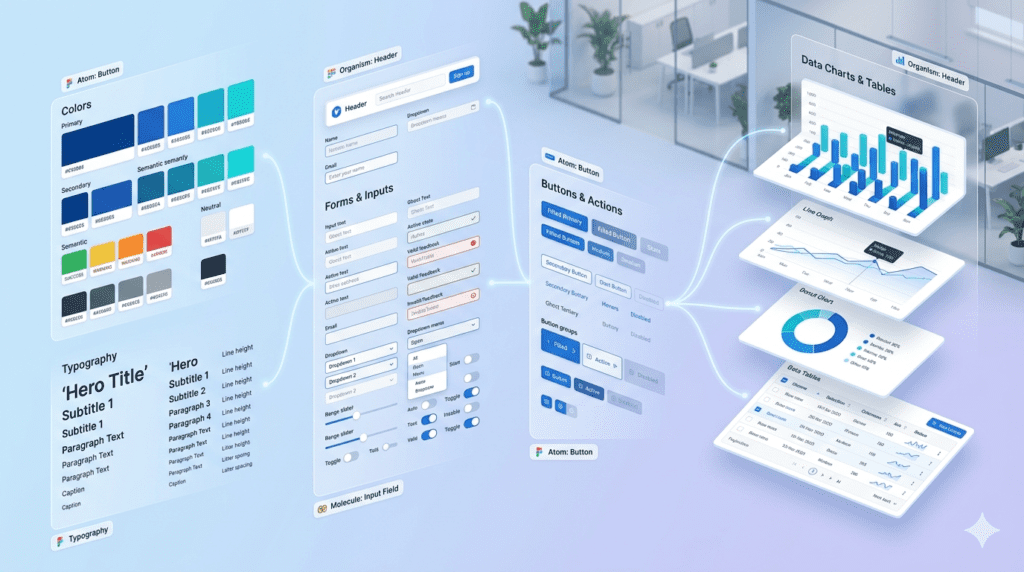
2. Component-Driven Design Systems
A strong SaaS product is built on a consistent design system.
Benefits include:
- Consistency across features
- Faster development cycles
- Built-in accessibility
👉 Result: Reduced design debt and improved scalability
3. Continuous Feedback Loop (“Daily Delivery”)
Modern SaaS requires rapid iteration.
The Uitop model uses:
- Async feedback (Loom, Slack)
- Fast iteration cycles
- Built-in user feedback
👉 Result: Continuous product improvement
Case Study: Logistics SaaS UX Redesign
The Problem
- 14% monthly churn
- 21-day onboarding
- 12-click workflow
Users found the system too complex to learn.
The Solution
- Reduced workflow from 12 clicks to 3
- Introduced search-first navigation
- Conducted UX audit
- Implemented design system
The Results
- Churn: 14% → 4.2%
- Onboarding: 21 → 4 days
- Efficiency: +75%
- LTV: +28%
- ROI: 340%

UX ROI Formula
ROIUX=CostUX(LTVpost−LTVpre)−CostUX×100
AI and SaaS UX in 2026
SaaS UX is shifting toward intent-based systems.
Predictive UX
Interfaces anticipate user behavior and automate lead scoring to identify high-intent users.
Natural Language Interfaces
Users give commands instead of navigating
Example:
“Generate Q3 revenue report”
Agentic AI Workflows
Agentic AI workflows handle multi-step processes automatically.
👉 Result: Faster and frictionless user experience

Common SaaS UX Mistakes
- Prioritizing trends over usability
- Ignoring mobile experience
- Fragmented workflows
- High cognitive load
👉 These directly increase churn
Final Takeaway
SaaS UX design in 2026 is a direct growth driver.
The Uitop framework proves:
- Simpler UX reduces churn
- Faster workflows increase retention
- Better design increases revenue
If you’re not auditing UX regularly, competitors are already outperforming you.
Frequently Asked Questions
It improves usability and workflows in SaaS products to increase retention.
Poor UX creates frustration, leading users to leave.
A structured analysis to identify usability issues.
$15,000–$60,000 depending on complexity.
A UX approach focused on simplifying complex SaaS systems.
About the Author
Muhammad Talha Saeed is a SaaS and AI content strategist with 3+ years of experience in SaaS research, AI tools analysis, and digital marketing. He specializes in simplifying complex SaaS platforms, agentic AI systems, and automation workflows into actionable insights. His work focuses on SaaS evaluation, pricing models, and real-world use cases to help startups and growth teams make smarter technology decisions. Talha actively researches emerging AI tools and productivity systems, ensuring his content is based on practical testing, competitive analysis, and evolving market trends.
 Muhammad Talha Saeed
[…] guide. If your question is more specifically about interface usability and product UX, use the SaaS UX design guide […]