
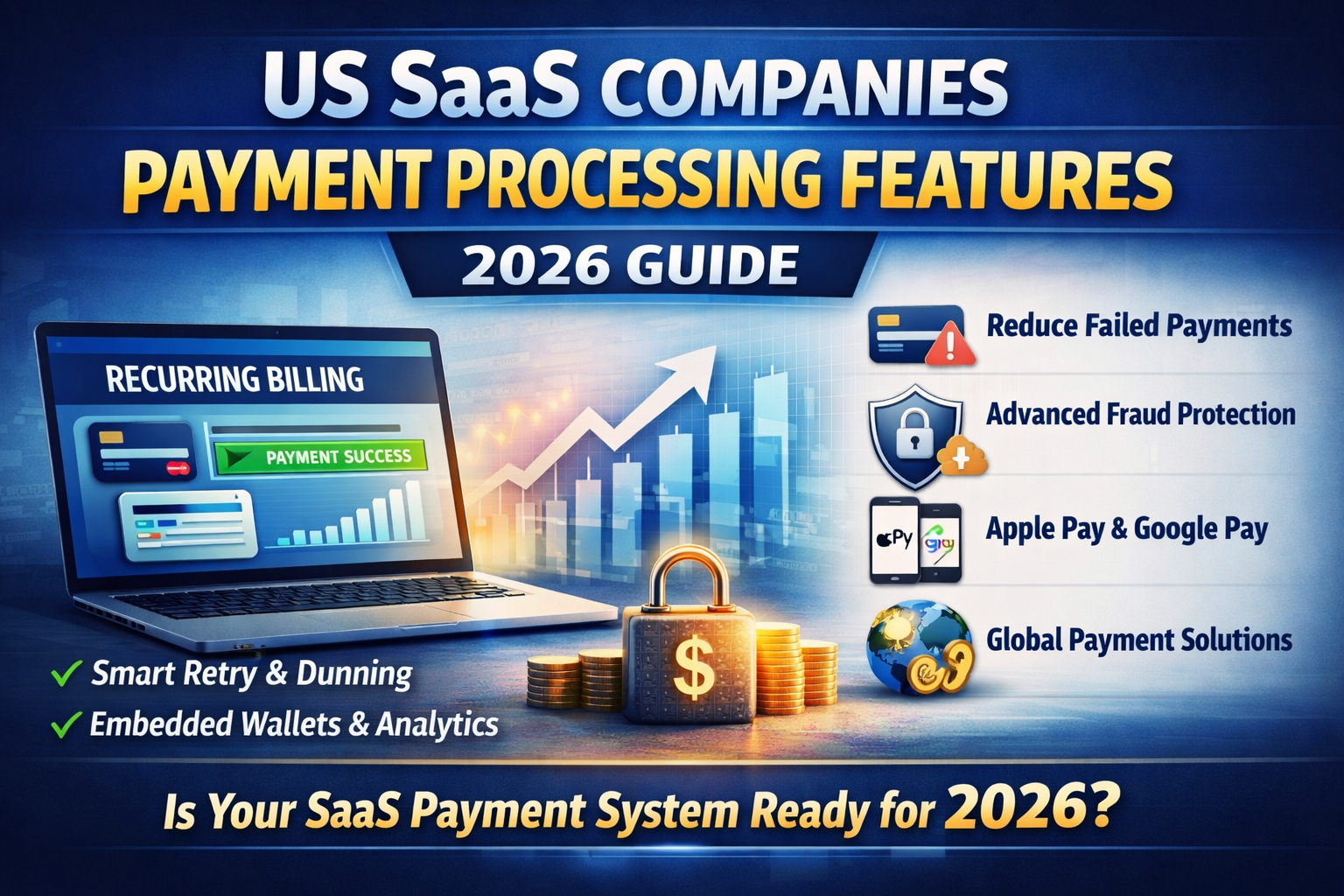
US SaaS companies payment processing features in 2026 aren’t just about charging cards. They decide whether revenue compounds or quietly leaks every month.
SaaS payment processing refers to the systems that manage recurring subscription charges, retries, upgrades, and secure transactions for software companies.

Payment processing features aren’t a “finance problem.” They decide whether your MRR compounds or leaks month after month. Recurring billing automation, smart retry & dunning management, embedded wallets, analytics — these aren’t nice-to-haves anymore. They’re table stakes.
Choosing the right payment gateway directly impacts revenue recovery and customer trust in SaaS businesses.”
— Forbes Technology Council
What Is SaaS Payment Processing?
- Handles recurring subscription billing
- Manages failed payments and retries
- Ensures secure and compliant transactions
What Payment Processing Really Means for SaaS
In SaaS, payments don’t end after checkout. That first charge is just permission to keep charging later.
Every renewal, upgrade, downgrade, usage spike, or card update runs through your payment system. When that system is fragile, it shows up as:
- involuntary churn
- support tickets you shouldn’t have
- revenue you “should” have collected but didn’t
Recurring billing automation handles the mechanics. Smart retry and dunning management clean up the mess when banks or cards fail. Payment gateway integration APIs keep everything talking to each other. Miss one of these, and things fall apart fast.
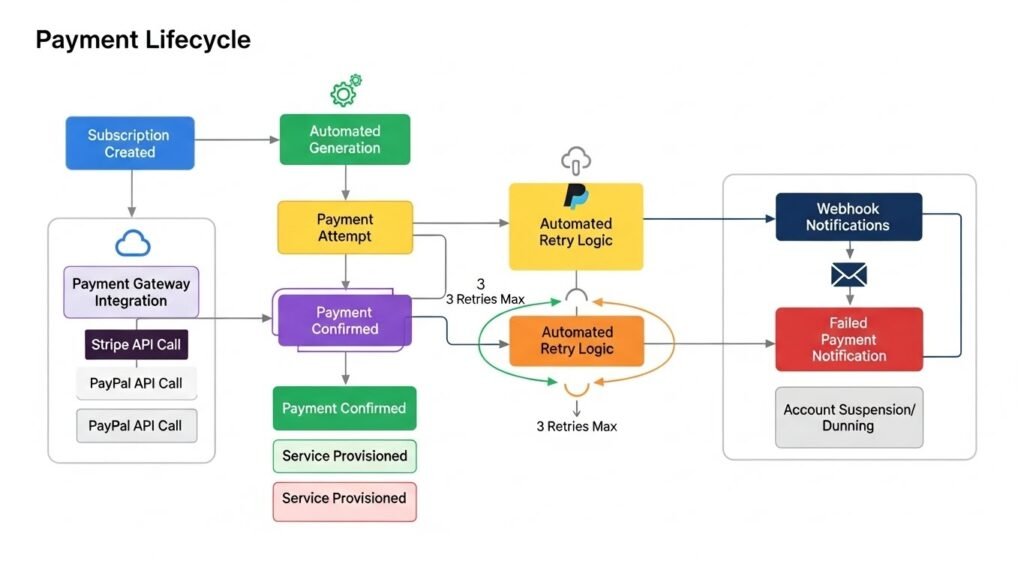
How SaaS Subscription Payments Actually Work (When They’re Not Broken)
A SaaS subscription is a living thing. Users change plans. Teams add seats. Usage spikes at the worst possible time.
Your billing system has to:
- trigger renewals automatically
- handle proration without confusing customers
- retry failed cards without locking accounts instantly
- reflect all of this in real-time analytics
When customers feel payment friction, they blame the product — even when billing is the real problem.
[Source: HubSpot – https://blog.hubspot.com/service/subscription-billing]
Why Payment Processing Hits US SaaS Companies Harder
The US market has no patience for clunky checkout flows.
- If Apple Pay or Google Pay isn’t available, conversion drops.
- If a card fails twice in a row, trust erodes.
- If an account gets locked over a temporary decline, churn spikes.
Strong payment processing features turn this around. Weak ones quietly cap your growth.
Trust, Retention, and the Stuff Users Never Tell You
Customers don’t email you when their card fails once. They leave when it becomes annoying.
Embedded payments like Apple Pay and Google Pay remove friction at signup. Smart retry & dunning management fixes most failures before users even notice. That’s the sweet spot — recovery without confrontation.
When billing feels invisible, retention improves without you touching onboarding or features.
[Source: TechCrunch – https://techcrunch.com/2021/09/21/payment-optimization-saas/]
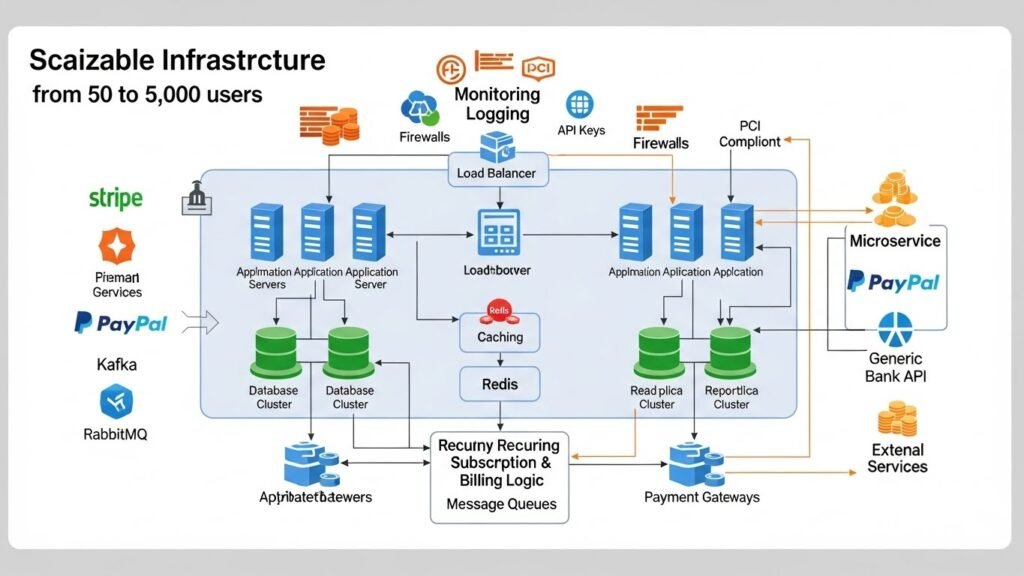
Scaling Gets Ugly Without the Right Payment Infrastructure
Manual billing works at 50 customers.
It collapses at 500.
At 5,000, it becomes a liability.
Recurring billing automation handles pricing changes and seat-based plans without engineering involvement every time. SaaS fraud prevention tools catch card testing and fake signups before your processor starts asking questions. Real-time payment analytics tell you when something breaks — not a month later.
This is where flexible payment gateway integration APIs matter. If your stack can’t grow with you, it will slow you down.
Recurring Billing Automation (This Is Non-Negotiable)
If billing isn’t automated, errors are guaranteed.
Recurring billing automation ensures:
- renewals don’t get missed
- upgrades don’t get undercharged
- discounts don’t break invoices
It’s the difference between predictable revenue and constant cleanup.
[Source: Stripe Docs – https://stripe.com/docs/billing]
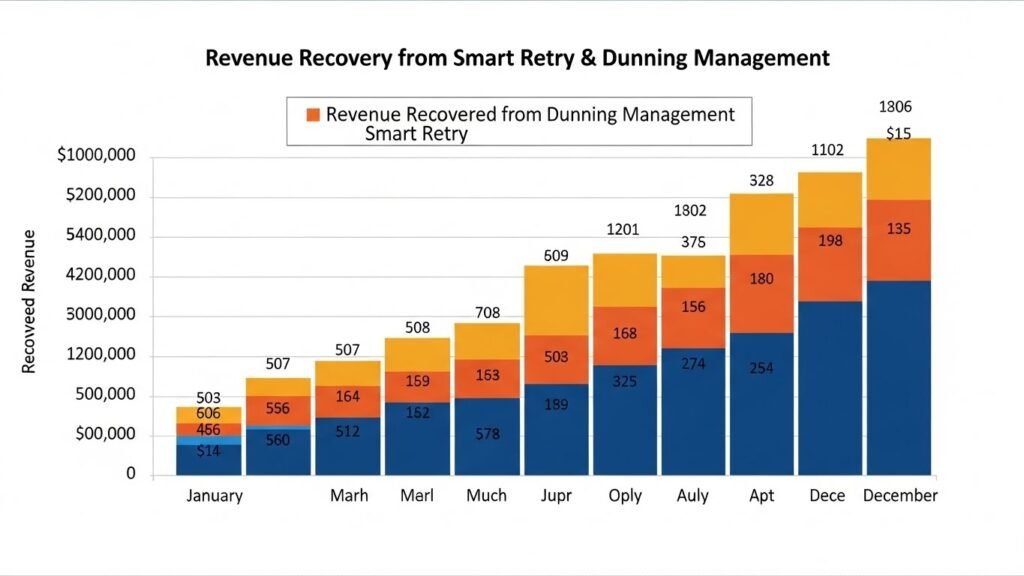
Smart Retry & Dunning Management: Where Lost Revenue Comes Back
Most churn isn’t intentional. Cards expire. Banks block charges. Payroll hits late.
Smart retry & dunning management retries payments at smarter times and nudges users only when necessary. Done right, it recovers revenue quietly. Done poorly, it annoys customers into cancelling.
This one feature alone can save a meaningful chunk of ARR.
Payment Methods That Don’t Kill Conversions
If users have to hunt for their wallet, you’re losing signups.
Embedded payments like Apple Pay and Google Pay reduce checkout friction dramatically. For global users, multi-currency payment support removes the mental math that makes people hesitate.
People pay faster when paying feels familiar.
[Source: Google Support – https://support.google.com/pay]
Payment Gateway Integration APIs (Where Data Either Flows or Dies)
Payments shouldn’t live in a silo.
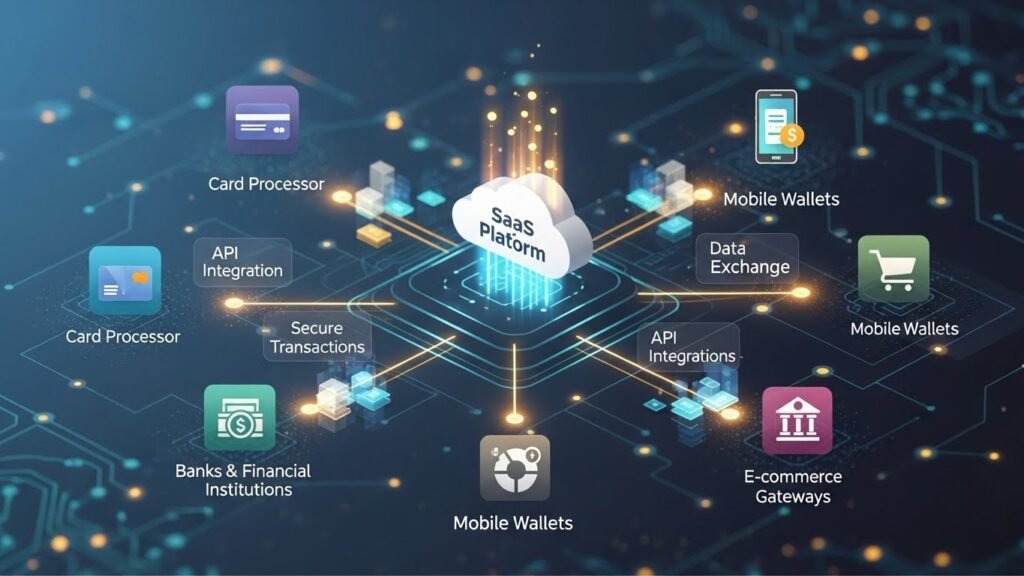
Strong payment gateway integration APIs sync billing data with:
- product usage
- CRM
- analytics dashboards
That’s how real-time payment analytics become useful instead of decorative. It’s also how SaaS fraud prevention tools spot patterns before chargebacks pile up.
Security, Compliance, and Not Getting Burned
Storing card data yourself is asking for trouble.
Tokenization, PCI DSS compliance, and embedded payment methods push risk to providers built for it. Apple Pay and Google Pay add biometric security without friction. Modern gateways handle encryption so your team doesn’t have to.
Security isn’t a growth lever — until it fails. Then it’s all anyone talks about.
[Source: PCI Security Standards – https://www.pcisecuritystandards.org/]
Checkout Isn’t a Utility. It’s Part of the Product
A generic checkout page breaks trust instantly.
Customizable checkout flows keep branding consistent and reduce drop-off. Mobile-friendly payment experiences matter more than most teams realize — especially for trial signups and self-serve plans.
If paying feels awkward, users hesitate. Hesitation kills conversions.

Real-Time Payment Analytics (Stop Flying Blind)
Waiting until month-end to see churn is too late.
Real-time payment analytics show:
- authorization rate drops
- retry success rates
- regional payment issues
This lets you fix problems while revenue is still recoverable.
[Source: HubSpot – https://blog.hubspot.com/service/payment-analytics]
Common Payment Problems US SaaS Companies Run Into
Most issues come from the same places:
- failed renewals with no recovery logic
- weak fraud prevention
- brittle gateway integrations
- no visibility into what’s breaking
These aren’t edge cases. They’re predictable failures of outdated setups.
Where SaaS Payments Are Heading Next
AI-driven fraud prevention is reducing false declines. Embedded finance keeps users inside the product. Usage-based billing is replacing flat plans — but only for teams with strong recurring billing automation and retry logic.
Payments are becoming part of the product, whether teams like it or not.
[IMAGE: Infographic showing future SaaS payment trends, including AI fraud prevention]
Alt-Text: US SaaS companies payment processing features 2026 AI-driven payment trends
Key Payment Processing Features US SaaS Companies Should Prioritize
The following payment processing features directly impact churn, revenue recovery, and customer trust for US SaaS companies.
- Recurring billing automation for predictable MRR
- Smart retry & dunning management to reduce involuntary churn
- Embedded payments (Apple Pay, Google Pay)
- Multi-currency payment support for global users
- Real-time payment analytics for visibility
- SaaS fraud prevention tools to protect margins
When these work together, billing stops leaking revenue and starts supporting growth.
Final Thoughts
Most SaaS teams don’t have a growth problem. They have a payment problem they don’t see yet.
Fixing your payment processing features won’t make headlines. It won’t impress investors in a demo. But it will quietly protect revenue, reduce churn, and make everything else work better.
That’s how serious SaaS companies operate.
FAQs: US SaaS Companies Payment Processing Features (2026)
In 2026, US SaaS companies need payment processing features like recurring billing automation, smart retry and dunning management, embedded payment methods (Apple Pay, Google Pay), real-time payment analytics, and fraud prevention tools. These features reduce failed payments and protect monthly recurring revenue.
Payment processing features reduce involuntary churn by automatically retrying failed payments, updating expired cards, and notifying users only when action is needed. This prevents customers from losing access due to temporary payment issues.
Recurring billing automation ensures subscriptions renew correctly without manual work. It handles upgrades, downgrades, proration, and usage-based billing, helping SaaS companies avoid billing errors and revenue leakage as they scale.
Yes. Multiple payment methods increase conversions and reduce checkout friction. US users expect options like credit cards, Apple Pay, Google Pay, and sometimes ACH payments, especially for self-serve SaaS products.
Smart retry systems attempt failed payments at optimized times instead of random retries. Dunning workflows politely remind customers only when needed, recovering lost revenue without damaging customer trust.