
If your 2026 budget was built on 2024 assumptions, you’re already facing a deficit.
As of January 2026, the SaaS industry has officially moved past the “Great Price Surge.” We are now in what industry experts call “Careful Complexity.” Vendors aren’t just raising rates; they are fundamentally re-engineering how they extract value through Agentic Pricing and Hybrid Monetization.
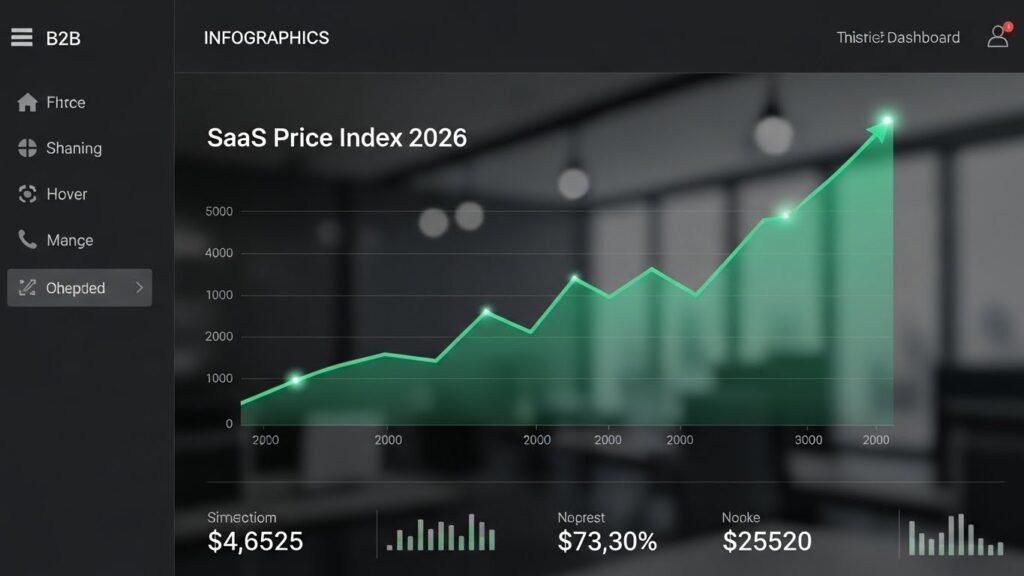
The brutal reality? SaaS inflation is currently hitting 11.4%, nearly 5x the average G7 market inflation. While corporate IT budgets are only growing at 2.8%, software costs are skyrocketing.
1. The January 2026 Price Log: Who is Raising What?
The current SaaS pricing news is dominated by the “Big Four” who are setting the pace for the rest of the industry. According to Forrester’s 2026 B2B Predictions, ungoverned use of Generative AI alone is set to cost companies billions, driving vendors to hike rates:
- Microsoft: Pushing increases of 5% to 40% across M365 and Power BI Pro. Notably, they’ve introduced a monthly billing penalty, making flexibility 5% more expensive than annual commitments.
- Salesforce: Following a 9% hike in 2023, they’ve slipped in another 6-9% increase in 2025-26, largely driven by mandatory Agentforce bundling.
- Google Workspace: Prices jumped 16.7% recently as Gemini AI features moved from “optional” to “integrated.”
- Adobe: Rebranded “Creative Cloud All Apps” to “Creative Cloud Pro,” resulting in a 17% price hike for existing subscribers.
💡 Expert Perspective: Price Increases as Growth Engines
“For legacy vendors like Salesforce, price increases now account for up to 72% of forward ARR growth. They aren’t winning new customers; they are taxing their installed base. As an operator, you must realize that you are the primary source of their margin expansion.” — Muhammad Talha Saeed, Senior SaaS Strategist
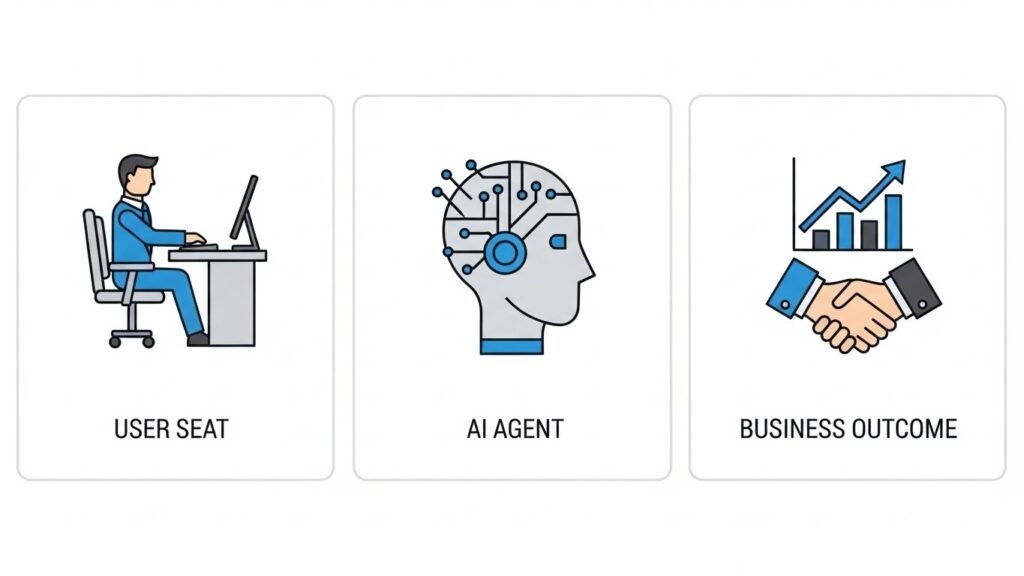
2. The Rise of “Agentic Pricing” (Beyond the Seat)
- The Agentic Seat: You license an AI agent (e.g., a “Digital Customer Service Agent”) just like a human employee, often at a premium rate.
- Outcome-Based Pricing: You pay only for “Successful Resolutions” or “Qualified Leads.” Intercom and Zendesk are leading this pivot.
- Credit Multipliers: Vendors give you “credits” but reserve the right to change how many credits a single AI task costs—essentially a silent price increase.
3. Solving the “Usage-Based Pricing” Trap
Forbes recently called usage-based pricing the “model everyone hates.” Why? Because it’s unpredictable.
However, in 2026, Cloud Management data shows that 47% of SaaS companies are piloting outcome or usage-based models. To survive this, procurement teams are adopting Predictive Billing Logic. Gartner’s 2026 Strategic Trends report highlights that multiagent systems will dominate, making these billing nuances critical.
Pro-Tip: Never sign a usage-based contract without a “Burst Cap” or “Credit Rollover” clause. If your usage spikes unexpectedly, a cap prevents a budget-busting invoice. If you under-utilize, a rollover ensures you don’t lose the value you’ve already paid for.
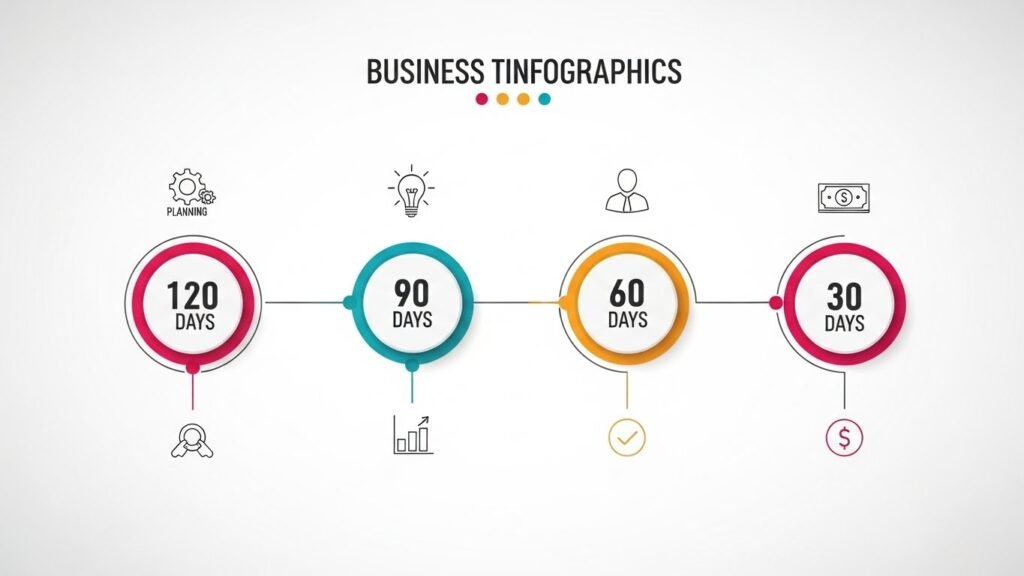
4. The 120-Day “Negotiation Power” PlayBOOK
To combat rising costs, you cannot be reactive. Data from Tropic’s 2026 Spend Analysis shows that companies starting renewals 6 months early save 39% more than those starting 30 days out.
Your 2026 Procurement Roadmap:
- Day 120 (The Audit): Identify Shadow AI. Find out which employees are expensing unauthorized AI tools.
- Day 90 (The Rationalization): Do you really need both Slack AI and Microsoft Copilot? Consolidate for better [IT Budgeting].
- Day 60 (The Benchmark): Use competitive quotes from HubSpot or Dynamics 365 as leverage against Salesforce.
- Day 30 (The Lock-In): Negotiate a Price Protection Clause that limits future annual increases to 2-3%.
5. FAQ: SaaS Pricing News 2026
1. How does SaaS pricing work? In 2026, SaaS pricing is no longer just a flat monthly fee. Most modern vendors use a Hybrid Model. This usually includes:
- Base Fee: A fixed cost for platform access and security.
- Variable Layer: Extra charges based on the features you use or the amount of data you process. This ensures you only pay for the core infrastructure plus the specific value you consume.
2. What is a key benefit of the subscription-based model? The biggest advantage is predictability. For businesses, it turns large, one-time hardware costs (CapEx) into stable monthly operating expenses (OpEx). It also guarantees that you always have the latest version of the software, as updates and AI security patches are included in your subscription.
3. What is usage-based pricing for SaaS? Usage-based pricing (also called “consumption-based”) means you are billed based on your activity. Common metrics include:
- Number of API calls.
- Amount of data storage used.
- AI tokens consumed. It is trending in 2026 because it is fair; if your usage drops, your bill drops automatically.
4. How do you price a new SaaS product? To price a product successfully today, follow these three steps:
- Value-Mapping: Determine exactly how much money or time your tool saves the customer.
- Market Benchmarking: Analyze what competitors charge for similar “AI-agentic” capabilities.
- Tiered Structure: Offer a “Starter” tier for adoption and a “Usage-based” tier for scaling enterprise clients.
5. What are the latest SaaS pricing trends in 2026? The market has shifted toward “Careful Complexity.” Vendors now bundle advanced AI features into higher tiers while adding usage-based “kickers.” This allows software companies to cover high GPU costs without raising the base price for every single user.
6. How is AI changing SaaS pricing? AI is causing the “Death of the Seat.” Since AI agents can now perform the tasks of multiple employees, charging “per human head” is losing relevance. Most vendors are moving toward Outcome-Based Pricing, where you pay for specific results like “Lead Qualified” or “Ticket Resolved.”
7. How can I protect my budget from price hikes? The most effective strategy is proactive negotiation.
Negotiate for Credit Rollovers so unused usage-based fees don’t go to waste.
Start your renewal process 120 days early.
Demand Price Escalation Caps (limit annual increases to 3-5%).
Author Bio
Muhammad Talha Saeed, Senior SaaS Strategist & Founder of The Growth Lens With over a decade of expertise in SaaSOps, Muhammad helps organizations navigate the shifting tides of cloud procurement. He specializes in auditing AI spend and building high-performance SaaS governance frameworks that bridge the gap between IT and Finance.
{
  "@context": "https://schema.org",
  "@type": "FAQPage",
  "mainEntity": [
    {
      "@type": "Question",
      "name": "What is the latest SaaS pricing news in 2026?",
      "acceptedAnswer": {
        "@type": "Answer",
        "text": "SaaS pricing in 2026 is defined by 'Careful Complexity,' featuring 11.4% inflation and a shift toward Agentic and Outcome-based models led by Microsoft, Salesforce, and Google."
      }
    },
    {
      "@type": "Question",
      "name": "How is AI changing SaaS pricing models?",
      "acceptedAnswer": {
        "@type": "Answer",
        "text": "AI is shifting the metric from 'Time spent in app' to 'Work completed by agent.' This makes 'per-seat' pricing less relevant and 'per-outcome' or 'agentic units' more common."
      }
    },
    {
      "@type": "Question",
      "name": "How can I protect my SaaS budget from 2026 price hikes?",
      "acceptedAnswer": {
        "@type": "Answer",
        "text": "The best defense is early engagement (120+ days before renewal), negotiating 'Price Protection Clauses' capped at 3%, and auditing credit multipliers to prevent silent hikes."
      }
    },
    {
      "@type": "Question",
      "name": "What is a Credit Multiplier in SaaS billing?",
      "acceptedAnswer": {
        "@type": "Answer",
        "text": "A Credit Multiplier is a mechanism where vendors charge 'credits' for tasks but can change the 'weight' of those tasks (e.g., from 10 to 15 credits) at their discretion, leading to hidden costs."
      }
    }
  ]
} Muhammad Talha Saeed