

Choosing the right SaaS website design agencies requires more than looking at rankings. SaaS companies should compare agency experience, website strategy, development capabilities, CMS expertise, SEO approach, pricing structure, and post-launch support before requesting proposals.
There is another distinction to make before building a shortlist. A public SaaS marketing website and the logged-in SaaS product are related design problems, but they are not the same job. UITOP, for example, describes its SaaS offering around product discovery, UX/UI, engineering, integrations, and ongoing software evolution—work that extends well beyond a typical marketing-site engagement.
The five providers below are not ranked from best to worst, and this list is not intended to represent the entire SaaS design-agency market.
How This Comparison Was Built
This comparison uses a deliberately small research set. A provider was included when current public sources contained enough information to assess at least part of its relevance to SaaS or B2B marketing websites.
For services, pricing, and timelines, the preferred evidence is the provider’s own current service or pricing page. Company-reported performance claims remain company-reported; they are not treated as independently verified outcomes.
Information was rechecked on August 27, 2026.
When this article says “not found in sources checked,” it means exactly that. It does not prove that the agency does not offer the service.
SaaS Website Design Agency vs. SaaS Product Design Agency
A SaaS marketing website usually needs to explain the software clearly, build confidence, and move a prospective buyer toward an action such as requesting a demo, starting a trial, or contacting sales.
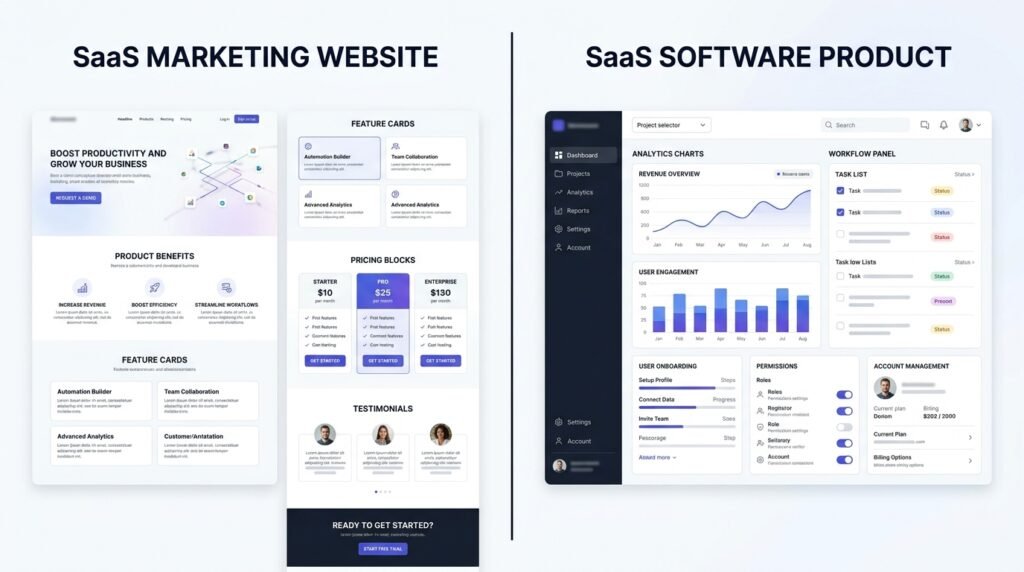
The SaaS product itself has a different job.
Marketing Website vs. Product Scope
| SaaS marketing website | SaaS product/application |
|---|---|
| Homepage | Dashboard |
| Feature pages | Logged-in workflows |
| Use-case pages | Roles and permission interfaces |
| Pricing pages | In-product onboarding |
| Comparison pages | Product design systems |
| Campaign landing pages | Operational workflows |
| CMS and content publishing | Application architecture |
| Demo or trial paths | Product activation |
This distinction matters when you review portfolios.
An agency can be strong at dashboard and workflow design without being the right partner for positioning, website copy, CMS development, or a search-sensitive migration. The reverse is also true: a capable Webflow marketing-site studio may not be the right team to redesign complex account permissions, onboarding flows, or application logic.
If you expect one provider to handle both areas, look for evidence in both rather than assuming that “web design,” “UI/UX,” and “product design” describe the same capability.
For deeper product-side planning, see AI SaaS Writer’s SaaS product design guide. If your question is more specifically about interface usability and product UX, use the SaaS UX design guide instead.
5 Best SaaS Website Design Agencies to Compare

The comparison below includes only information supported by the current public sources reviewed for this article.
| Agency | Publicly documented scope | Public price/timeline signal | Important scope note |
|---|---|---|---|
| Veza Digital | B2B SaaS/enterprise, Webflow design and development, SEO, CRO, integrations | Transformation starts at $20,000/project; typically 6–10 weeks | Broader growth and Webflow model |
| WeGrowth | SaaS growth, web design/development, messaging, analytics, CRO | Standalone website price and timeline not found in sources checked | Website work sits inside broader growth services |
| Wavespace | Website design, landing pages, SaaS design, Webflow design/development | $500 one-week UX design trial; not a full website quote | Significant product/UI-UX positioning |
| Aimers | Landing pages, SaaS homepages, copy, UI/UX, development, analytics, CRM integration | Simpler landing pages $2,000–$5,000; complex pages $5,000–$15,000+; generally several weeks | Pricing and timing apply to its landing-page service |
| Excited | SaaS website design, UX, development, redesign, and post-launch work | Price and standard website timeline not found in source checked | Also performs product-design work |
These figures should not be combined into an “average SaaS website price.” They refer to different services and scopes.
Veza Digital
Veza Digital serves B2B SaaS and enterprise companies with Webflow design and development, integrations, SEO, migration services, CRO, and ongoing website support.
Its current pricing page gives buyers a useful qualification signal. As of August 27, 2026, Veza’s project-based Transformation engagement starts at $20,000 per project. The listed scope includes a design and development audit, redesign work, technical SEO and analytics infrastructure, tracking setup, and foundational CRO/AEO recommendations. Veza says this phase typically takes 6–10 weeks, depending on design complexity, content volume, and integrations.
That public starting point can help a buyer determine whether it is worth entering a detailed sales process. It remains Veza’s own current commercial offer, not an industry benchmark.
Potential fit: A B2B SaaS company planning a Webflow-centered redesign where technical SEO, analytics, and conversion considerations need to be part of the same engagement.
Verify in the proposal: exact page scope, copy responsibility, migration work, analytics configuration, revision process, and what happens after the initial Transformation engagement.
WeGrowth
WeGrowth positions itself as a broader SaaS growth partner rather than a design-only agency. Its current site lists Web Design & Development alongside Data & Analytics, Content & Messaging, and Conversion Rate Optimization. It also lists specialist roles including UI/UX and web design, development, analytics, copywriting, and landing-page development.
That wider model may suit a company that sees the website as part of an acquisition or growth system rather than as an isolated redesign.
It also means buyers should not assume that WeGrowth’s commercial model will resemble a conventional fixed-scope website project. A clearly isolated standalone SaaS website redesign price or website-project timeline was not found in the sources checked.
Potential fit: A SaaS team that wants its website connected to messaging, acquisition, analytics, and wider growth execution.
Verify in the proposal: whether the engagement is project-based or subscription-based, who owns copy and development, the proposed technical stack, how much capacity is dedicated to the website, and what support remains after launch.
Wavespace
Wavespace’s services page currently lists Website Design, Landing Page Design, SaaS Design, Webflow Design, Product Design, CRO, and Webflow Development.
The same service ecosystem currently advertises a one-week trial for $500. The offer is positioned as a way to evaluate the team’s UX/design process before making a larger commitment. It is not a quoted price for a complete SaaS marketing website.
Wavespace therefore spans both website and product-design territory. That range may be useful when a company wants continuity between its public site and product experience, but it also makes scope clarity particularly important.
Potential fit: A SaaS company that may need website work alongside product, UI/UX, or Webflow capability.
Verify in the proposal: which team handles the marketing website, whether positioning and copy are included, full-project price and timeline, CMS architecture, and the division between website and product UX.
Aimers
Aimers’ SaaS landing-page service is especially relevant when landing pages, paid acquisition, and conversion work sit at the center of the project.
Its public service page discusses strategy, page structure, copywriting, UI/UX design, development, tracking, testing, and conversion-focused QA. The page also explicitly refers to SaaS homepage and website-design work where it supports paid acquisition or conversion goals.
Aimers currently says simple landing pages often start around $2,000–$5,000, while more complex pages can range from $5,000–$15,000+. It says most landing-page projects take several weeks, depending on strategy, copy, design complexity, feedback cycles, development requirements, and tracking setup.
Those numbers describe Aimers’ landing-page service. They should not be used as the expected cost or duration of a complete SaaS marketing-site redesign.
Potential fit: Paid-acquisition or campaign-heavy SaaS teams that need strategy, copy, design, development, and measurement around conversion pages.
Verify in the proposal: whether a full multi-page website is in scope, how pricing changes beyond landing pages, and who owns long-term CMS, search, and content responsibilities.
Excited
Excited’s SaaS website-design service covers research, wireframes, prototypes, visual design, developer handoff, website development, launch, and post-launch optimization. Excited states that it handles SaaS website design and development end to end.
Its offering spans website and product-design territory. That may be useful when a company wants continuity between its marketing site and software interface, but the proposal should make clear which capability will dominate the engagement.
A standalone public project price or standard website-project duration was not found on the service page checked for this article.
Potential fit: SaaS teams considering one partner for both website work and broader product-design or development needs.
Verify in the proposal: marketing-site portfolio relevance, positioning and copy ownership, technical stack, analytics responsibilities, and the balance between website and product work.
Compare Agencies Using the Same Questions
Agency websites naturally emphasize their strengths. A more useful comparison starts with the same questions for every candidate.
Is the Portfolio Relevant to Your Project?
A long logo wall is not enough.
For each relevant example, ask:
- Was it a marketing website or a product interface?
- What did the agency actually deliver?
- Did it handle strategy, copy, design, and development?
- Was a CMS migration involved?
- Is the project similar to your buyer journey or company stage?
- Are reported performance results independently supported or provider-reported?
A recognizable client name may demonstrate that a relationship existed. It does not tell you by itself who wrote the copy, who developed the site, what was migrated, or whether a reported outcome came from design alone.
Who Owns Strategy, Messaging, Copy, and Design?
Two proposals can carry similar price tags while covering very different work.
Clarify responsibility for:
- customer research;
- positioning;
- information architecture;
- messaging;
- copywriting;
- wireframes;
- UI design;
- responsive design;
- product visuals;
- development.
If one proposal includes research, copy, development, analytics, and launch support while another includes visual design only, the headline prices are not comparable.
What Will the Agency Actually Build?
Determine whether you are buying design files, a production-ready site, or both.
Ask:
- Which CMS or framework will be used?
- Who owns the hosting and platform accounts?
- Can marketers build new pages internally?
- Are reusable components included?
- Who handles integrations and QA?
- What documentation and training are included?
- What support remains after the engagement?
If URLs change during a redesign or CMS migration, Google’s site-move guidance recommends planning old-to-new URL mappings, using appropriate permanent redirects, updating internal links, and monitoring the migration.
Migration responsibility should therefore be agreed before launch rather than discovered when traffic or indexing problems appear.
Who Owns SEO, Performance, and Analytics?
A redesign affects more than appearance.

For search-sensitive projects, clarify responsibility for:
- URL mapping;
- redirects;
- metadata;
- internal links;
- sitemap updates;
- indexability checks;
- post-launch monitoring.
Core Web Vitals measure aspects of real-world loading performance, responsiveness, and visual stability. Google recommends good Core Web Vitals, but Google’s page-experience documentation makes clear that good page-experience signals do not guarantee top rankings.
Measurement also needs to be agreed before development is complete. GA4 events can measure interactions or occurrences, while Google’s recommended-events documentation includes examples such as generate_lead and sign_up.
For a SaaS website, the useful question is not whether an agency promises a “conversion-focused” design. It is whether everyone agrees on which actions count as conversions and who is responsible for measuring them correctly.
What Happens After Launch?
WCAG 2.2 is a W3C Recommendation containing accessibility success criteria.
That does not mean the same legal obligation applies in every jurisdiction, so location-specific compliance claims still require appropriate legal review.
Ask:
- Which accessibility standard is included?
- How is accessibility tested?
- Who fixes issues found after launch?
- Who handles new pages?
- Who maintains integrations?
- What support model is available?
- What happens when the initial engagement ends?
A website is an operating asset, not just a launch deliverable.
What to Put in Your Agency Brief
A useful brief gives every provider the same problem to price and solve.
Define the Website’s Job
Write down:
- the primary audience;
- the main conversion action;
- whether the project is a redesign, migration, or new build;
- the main problem with the current site;
- important page types;
- key integrations;
- how success should be measured;
- any fixed technical constraints.
“Make the website modern” is difficult to scope.
“Help enterprise buyers understand the product and create a clearer route to requesting a demo” gives an agency a more useful problem to solve.
Define the Deliverables
Mark each item as:
- agency responsibility;
- internal responsibility;
- undecided.
Cover:
- research;
- positioning;
- information architecture;
- messaging;
- copy;
- UX;
- UI;
- development;
- CMS setup;
- migration;
- analytics;
- integrations;
- QA;
- training;
- launch;
- maintenance.
This makes scope gaps visible before they become change requests.
Define Ownership
Confirm:
- CMS account ownership;
- hosting;
- design files;
- reusable components;
- analytics access;
- CRM and forms;
- redirects;
- documentation;
- post-launch support.
These details often matter more after launch than they do during a design presentation.
How to Interpret Pricing, Timelines, and Performance Claims
Pricing
This research found some current provider-specific price signals, including Veza’s project-based starting price and Aimers’ landing-page ranges.
That still does not justify calculating a general “average SaaS website design agency cost.”
The services are not equivalent.
A quote can change according to:
- strategy;
- copy;
- branding;
- page count;
- development;
- CMS work;
- content migration;
- integrations;
- analytics;
- accessibility;
- testing;
- ongoing support.
Compare the scope behind the number, not just the number itself.
Timelines
The same rule applies to duration.
Veza currently states a 6–10 week timeline for its Transformation phase, while Aimers describes its landing-page projects as generally taking several weeks. These are useful provider-specific signals, not evidence that every SaaS website should follow the same schedule.
Ask what each timeline assumes about:
- copy completion;
- stakeholder approvals;
- revision rounds;
- migration;
- integrations;
- development;
- QA.
A timeline without its assumptions is difficult to compare.
Performance Claims
Treat an agency case study as evidence of what the agency reports unless the underlying outcome has stronger independent support.
Ask:
- What changed?
- What was the baseline?
- What period was measured?
- Did traffic sources change?
- Did pricing or positioning change too?
- Who measured the result?
- Can the agency explain the calculation?
Agency-authored rankings can still be useful for discovery, but their commercial context matters. Provider claims should be checked against underlying evidence rather than accepted solely because a roundup ranks the company highly.
Build Your Final Shortlist
Use the same decision matrix for every candidate.
There is little value in turning this into an artificial 9.7/10 score.
Different projects should weight different factors differently. A large migration may make CMS architecture, redirects, and technical QA non-negotiable. A smaller SaaS launch may care more about positioning, copy, collaboration, and the ability to move quickly.
The final shortlist should reflect the job your website needs to do.
Frequently Asked Questions
Not always. SaaS-specific experience can be useful when the site needs to explain an abstract software product, support demos or trials, and communicate to buyers comparing several options. Relevant portfolio evidence and delivery capability still matter more than having “SaaS” in the agency’s positioning.
Only when it can demonstrate credible capability in both. Marketing-site work focuses on communicating and converting before login; product design includes workflows, dashboards, permissions, onboarding, and ongoing application use.
If product UX is part of your project, use the SaaS product design guide or SaaS UX design guide for that separate evaluation.
Only if your organization already has a fixed technical requirement. Otherwise, define internal editing needs, integrations, ownership, migration requirements, maintenance, and technical resources first, then evaluate platforms against those needs.
If organic-search requirements are a major factor in the platform decision, see AI SaaS Writer’s Best CMS for SEO guide.
There is no evidence-backed universal number in this research. Create a manageable shortlist of providers that meet the same essential requirements, then compare their proposed scope, responsibilities, pricing assumptions, and commercial terms.
 Talha Saeed
[…] SaaS companies need strong branding to communicate complex solutions and build customer confidence. […]