
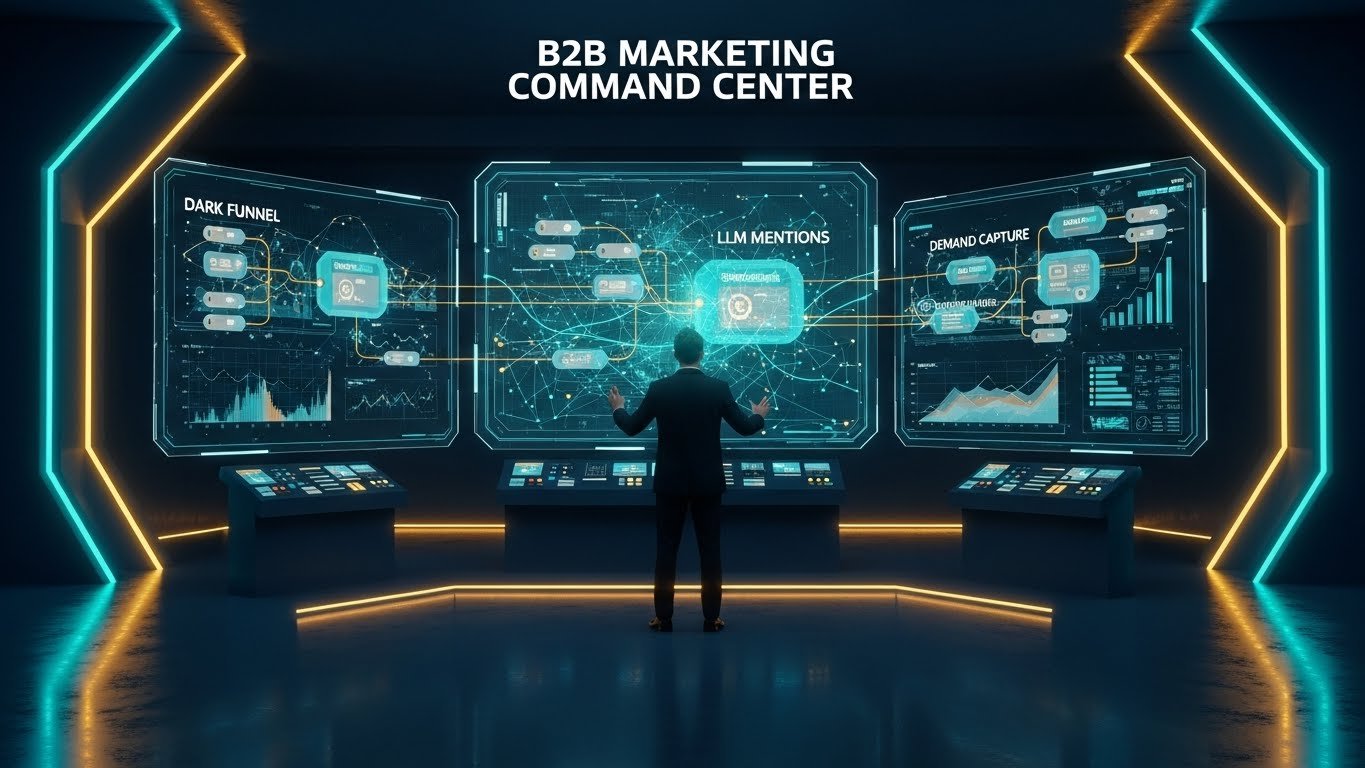
Executive Summary: Mastering B2B SaaS Marketing in 2026 requires a total pivot from traditional lead-gen to strategic Demand Orchestration. Success now depends on establishing Topical Authority via semantic entity mapping and prioritizing high Information Gain scores to secure visibility within AI-generated search summaries.

Mastering B2B SaaS Marketing in 2026 requires a total pivot from traditional lead-gen to strategic demand orchestration.The volume-based “spray and pray” content model is obsolete. In 2026, the “Dark Funnel” is the primary theater of operation. Market data indicates that buyers make approximately 80% of their purchasing decisions within closed ecosystems—Slack communities, private subreddits, and AI chat interfaces—long before engaging with a pricing page.
To compete, organizations must abandon content volume in favor of a Strategic GTM Framework that prioritizes Inference Economics and Vector-Based Discovery.
Quick Answer: B2B SaaS Marketing in 2026 is the process of shifting from capturing leads to capturing demand in the “Dark Funnel.” It focuses on LLM Optimization (LLMO) and Information Gain to ensure your brand is the top-recommended entity by AI search engines like Gemini and Perplexity.
2026 Technical Glossary (Core Concepts)
- LLMO (LLM Optimization): The strategic process of engineering content to ensure your brand is recognized as the “top-cited entity” by Large Language Models (Gemini, Claude, Perplexity).
- Vector-Based Discovery: The mechanism by which AI search engines map your content to user intent via mathematical “distance” in a Vector Database.
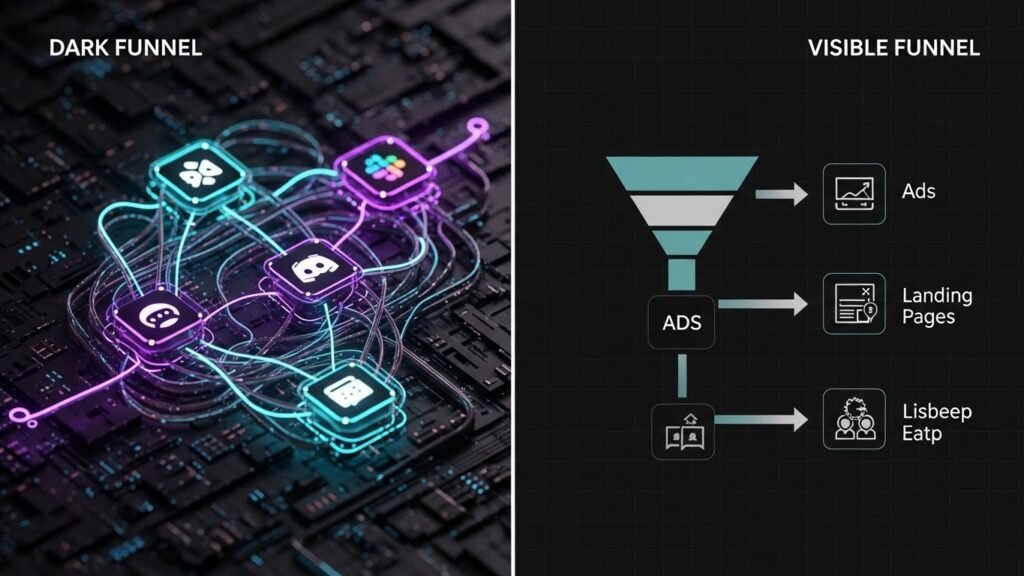
- Dark Funnel: The aggregation of buyer journey touchpoints occurring in non-trackable, private digital spaces, invisible to traditional attribution software.
The Problem: The Collapse of the Legacy Funnel
The traditional “Awareness to Purchase” linear funnel is no longer viable. The modern buyer journey is asynchronous, non-linear, and deeply skeptical of traditional sales mechanisms.
Deep Dive: Measuring Dark Funnel Success in B2B
Dark Funnel signals ko track karna aur unhe revenue se connect karna 2026 ki sabse bari marketing skill hai. Is video mein B2B sales par iske asraat ko detail mein samjhaya gaya hai.
Key Timestamps & Insights:
- [00:02:12] – Number of ICP (Ideal Customer Profile) firms showing up in dark traffic.
- [00:03:50] – Moving from ‘Last Click’ to ‘Signal-Based’ influence models.
- [00:06:02] – Why AI makes Dark Funnel tracking possible now compared to 5 years ago.
- [00:16:05] – Shift from Reactive Inbound to Proactive Intent Orchestration.
The Death of Gated Content and the MQL
Gating high-value assets behind lead forms is detrimental to your Topical Authority. The 2026 buyer demands Zero-Friction Access. If your intellectual property is locked behind a gate, Google’s Search Generative Experience (SGE) will simply summarize a competitor’s open-source content instead, bypassing your site entirely.
The Dark Funnel and Attribution Blindness
Legacy pixel-based tracking provides a false sense of accuracy. When a CTO learns of your solution via a podcast and subsequently searches your brand name in Perplexity, attribution software categorizes this as “Direct Traffic.”
This blindness leads to misallocated budgets. This is often referred to as the Platform Event Trap, where you fail to capture the true intent signal because you are relying on outdated pixel data. You are not losing leads; you are losing the visibility into what influences them.
The Strategic Solution: Shifting to Demand Capture & LLM Visibility
LLM Optimization (LLMO): Owning the Answer Engine
Ranking #1 on a SERP is no longer the sole objective. The goal is to establish your brand as the “Recommended Entity” when a user prompts Gemini with: “Which SaaS platform offers the best GPU-to-value efficiency?” Achieving this requires structuring content for Vector-Based Discovery, utilizing clear, interconnected semantic clusters.
Playbook: Ranking in ChatGPT, Gemini & Perplexity
Traditional SEO se hat kar AI-driven search engines (LLMs) mein apni jagah banane ka complete technical framework yahan dekhein.
Key Timestamps & Insights:
- [00:03:08] – How AI SEO differs from traditional Google keyword strategies.
- [00:06:37] – Creating ‘Best Fit Briefs’ to spoon-feed AI models your brand value.
- [00:09:42] – Using Comparison Tables to dominate AI decision-making.
- [00:14:08] – Off-page tactics for AI mentions (Reddit, Quora, and Industry Directories).
Product-Led Marketing (PLM) as a Revenue Engine
Native AI products must integrate marketing triggers directly into the UX. By classifying your software’s technical depth, you engineer natural viral loops.
Pro-Tip: Align your Go-To-Market messaging with your architectural reality. Use theAI SaaS Product Classification Criteriato audit your current product tier and ensure your feature sets match buyer expectations.
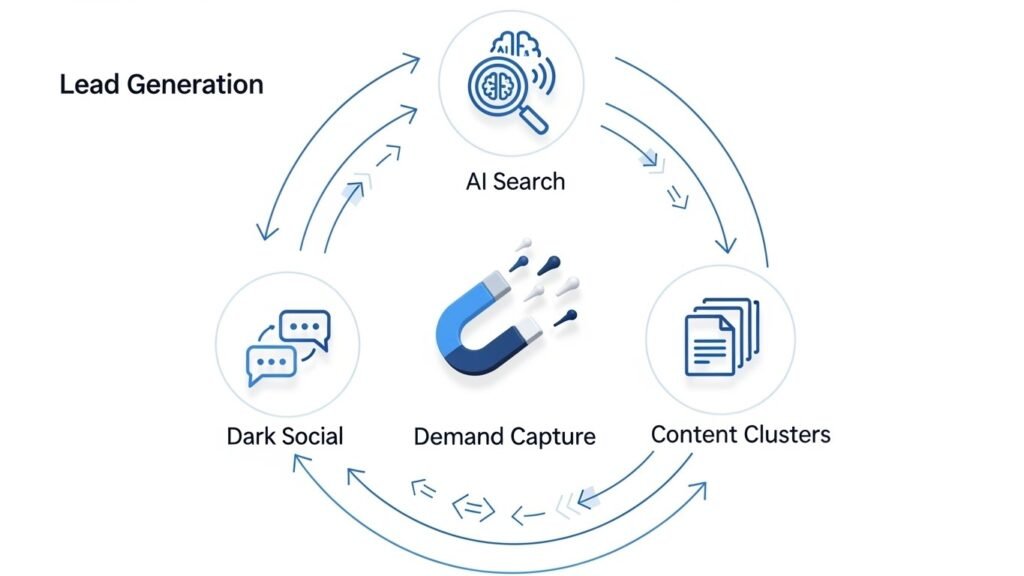
Meta Description: A technical GTM flowchart illustrating how modern SaaS brands capture existing
📝 B2B SaaS Marketing Readiness Checklist
- Move from MQLs to PQLs (Product Qualified Leads).
- Un-gate 80% of your high-value technical content.
- Optimize for LLM citations (Perplexity/Claude).
- Track signals in the Dark Funnel (Slack/Communities).
Implementation: The 2026 B2B SaaS Marketing Playbook
Semantic SEO: From Keywords to Entities
Marketing teams must cease chasing high-volume, low-intent keywords. The objective is to own the Semantic Entities your competitors overlook.
| Feature | Legacy SEO (Keyword Focus) | Modern SEO (Entity Focus) |
| Primary Goal | Clicks and Traffic | Share of Model (LLM Mention) |
| Content Structure | Linear Blogs | Multi-modal Knowledge Hubs |
| Success Metric | SERP Ranking | Information Gain Score |
Strategy: 90-Day Topical Authority Roadmap
Topical Authority build karne ke liye Hub Pages aur Supporting Content ka structure kaise banaya jata hai, uska practical demo yahan majood hai.
Key Timestamps & Insights:
- [00:00:10] – Roadmap creation: Hub pages, supporting pages, and internal linking.
- [00:01:26] – Silo structure depth for faster crawling and indexing.
- [00:02:21] – Importance of planning internal links BEFORE writing blog posts.
- [00:02:58] – Ranking in the Top 10 based on content authority without excessive backlinks.
Case Study: The Impact of Information Gain
- Company A (Horizontal Wrapper): Focused on generic “AI Writing” keywords. Experienced a 45% increase in CAC in 2026 due to saturation.
- Company B (Vertical AI): Published proprietary research on “Inference Cost Efficiency.” Despite lower search volume, they achieved 3x higher LLM Mentions, resulting in a 22% reduction in CAC.
Expert Perspective: The Veteran’s Audit
“The most critical error CMOs are currently making is the ‘Inference Cost Overlook.’ Treating AI-generated content as a commodity ignores the hidden cost to brand reputation. Real growth in 2026 stems from Vertical AI Architecture. Your marketing must reflect the Predictive RevOps capabilities of the software itself.”
— Lead Strategist, B2B Growth Partners
This technical foundation is what eventually drives lovable vibe coding revenue, creating a brand that developers and buyers intuitively trust.
The Technical Stack: Tools for Modern Demand Orchestration
- Intent Intelligence: Platforms capable of mapping Implicit Intent across fragmented data sources.
- Visual Trust: Utilization of modern tooling to demonstrate Level 5 autonomy in real-time.
- Data Sovereignty: Ensuring marketing data infrastructure complies with global standards, adhering to Gartner’s AI Security Guidelines.
[Image Placeholder 4: AI-Native RevOps Dashboard]
- Image Generation Prompt: A futuristic SaaS dashboard showing “Predictive RevOps Analytics.” Key metrics like “LLM Mentions,” “Dark Social Conversion,” and “Inference Cost Efficiency.” Sleek UI, dark mode, vibrant data visualizations, 8k resolution, 16:9 ratio.
- File Name (Rename before upload):
ai-native-revops-dashboard-2026.jpg - Alt Text: A visual representation of a modern B2B SaaS RevOps dashboard tracking AI-driven metrics.
- Caption: Track Implicit Intent and Inference Economics with AI-native RevOps dashboards.
- Meta Description: A mockup of a 2026 RevOps dashboard focusing on LLM mentions and inference cost efficiency metrics.’
Conclusion: The Path Forward
Success in the 2026 B2B SaaS landscape requires a fundamental shift in perspective. Moving from capturing clicks to capturing Semantic Authority is no longer optional—it is the baseline for survival. By focusing on Information Gain and LLM visibility, brands can bypass the noise of the legacy funnel and establish a permanent moat in the AI-driven economy.
Frequently Asked Questions (PAA)
Q1: What is B2B SaaS marketing in the age of AI?
A: B2B SaaS marketing in 2026 is no longer just about lead generation; it is about Demand Capture and LLM Optimization (LLMO). It involves ensuring your software is the “top-cited entity” in AI search engines like Gemini and Perplexity by building high Topical Authority and Semantic Clusters.
Q2: What are the best examples of B2B SaaS growth strategies for 2026?A: Successful examples now
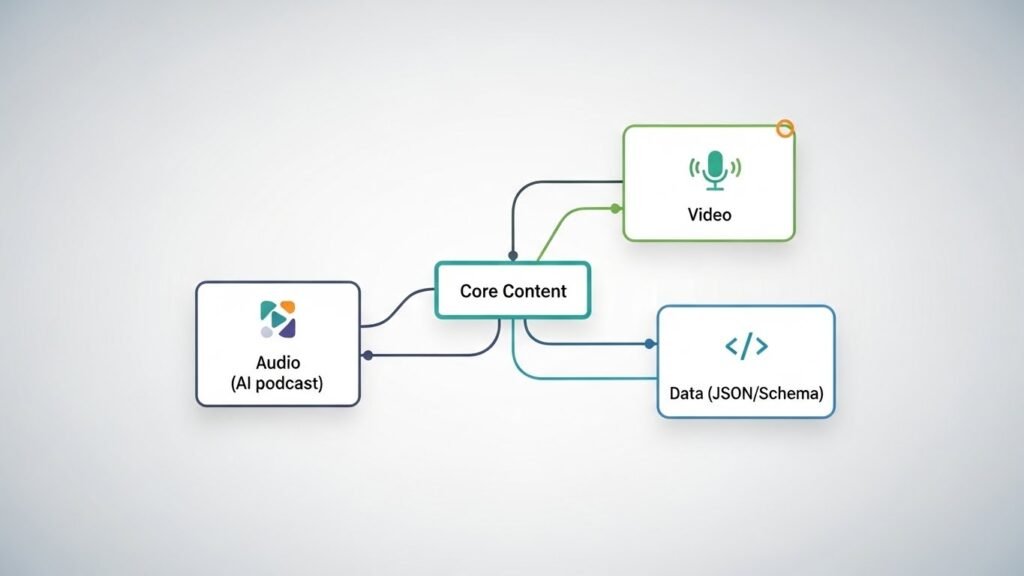
focus on Product-Led Marketing (PLM) and Inference Economics. Instead of traditional gated whitepapers, leading companies use “Zero-Friction” content hubs and multi-modal distribution (Video/Audio) to influence the Dark Funnel where 80% of buying decisions happen.
Q3: How do you promote B2B SaaS effectively to reduce CAC?
A: To reduce Customer Acquisition Cost (CAC), brands must shift from “Search Engine Optimization” to “Search Experience Orchestration (SEO).” By targeting high Information Gain scores and optimizing for AI-generated summaries, SaaS companies can see a 22% reduction in CAC compared to legacy “Keyword-stuffing” methods.
Q4: Do the 7 P’s of B2B marketing still apply in 2026?
A: Yes, but they have evolved. “Promotion” is now LLM Visibility, and “Place” has expanded into the Dark Funnel (Slack, Discord, private AI chats). The focus has shifted from simple placement to becoming a trusted “Vector” in an AI’s mathematical discovery database.
[…] has claimed a top spot in 2026 by integrating narrative depth with cinematic visual […]
[…] the granular data necessary for navigating the transition from traditional rank-based SEO to Generative Engine Optimization […]
[…] “Click Economy” that sustained the internet for 25 years has officially collapsed. By January 2026, over 58% […]
[…] For: SaaS and B2B organizations seeking a balance between high-end design and technical […]