
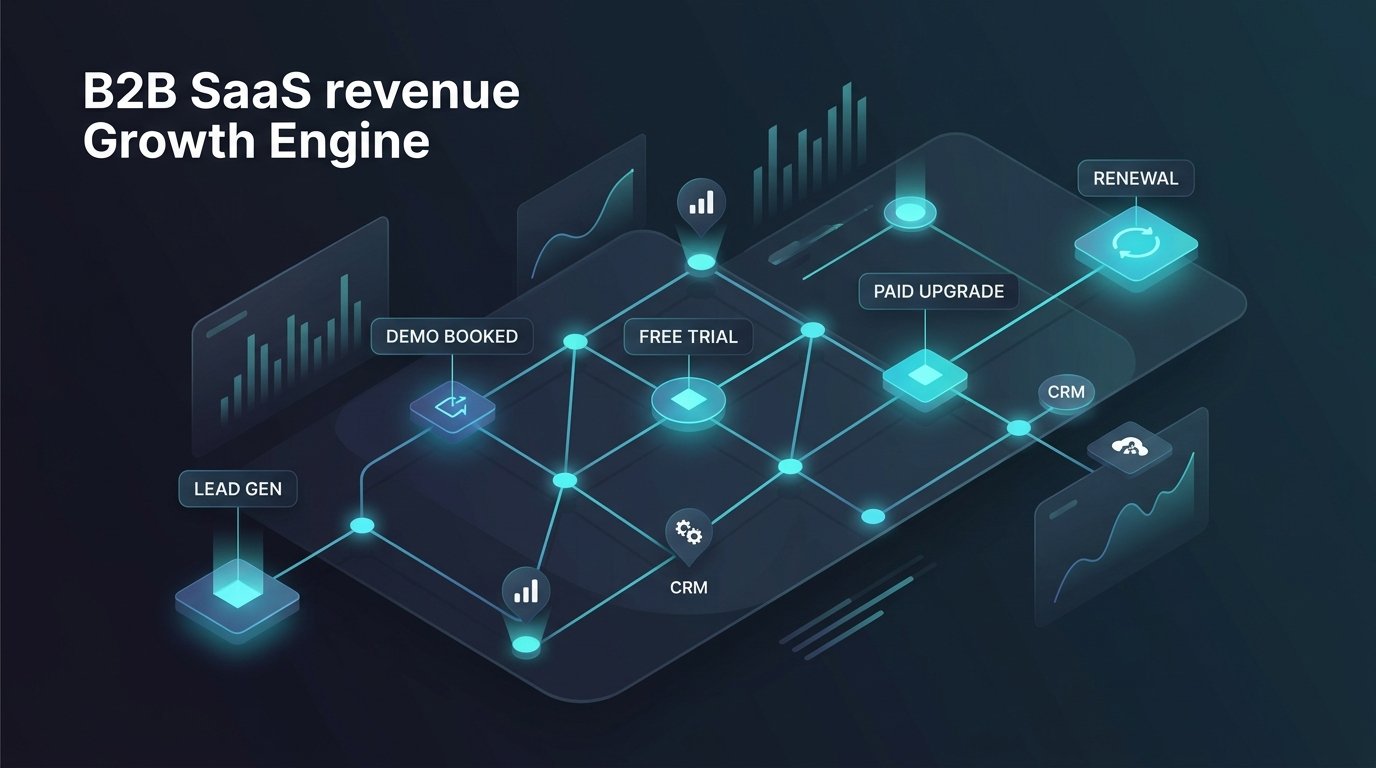
📌 What is SaaS Demand Generation? (Direct Definition)
Mastering SaaS demand generation is essential for B2B software companies transitioning away from friction-heavy lead capture. SaaS demand generation is an integrated go-to-market (GTM) operating strategy designed to generate category awareness, establish brand preference among out-of-market accounts, and capture high-intent pipeline for software platforms without conversion friction.
System Flow: Ungated Creation ──► First-Party Signal Detection ──► Intent-Driven Capture ──► Buyer Enablement
🧠 Executive Overview: AI Summary & Key Takeaways
🤖 AI Summary (GEO / AI Overview Snippet)
Modern B2B SaaS demand generation transitions software GTM from friction-heavy lead capture (gated whitepapers) to an open-education architecture. Grounded in the 95/5 Market Reality—where ~95% of target accounts are out-of-market at any given time—it operationalizes four core functions: Demand Creation (ungated preference), Signal Routing (intent detection), Demand Capture (frictionless booking), and Buyer Enablement (risk reduction).
🔑 Key Takeaways (Executive Summary)
- The Strategic Hero Concept (95/5 Rule): The 95/5 Rule explains why traditional marketing breaks (95% of target accounts are not actively buying today). Modern demand generation is the how: an operating framework to educate out-of-market accounts and capture active buyers without friction.
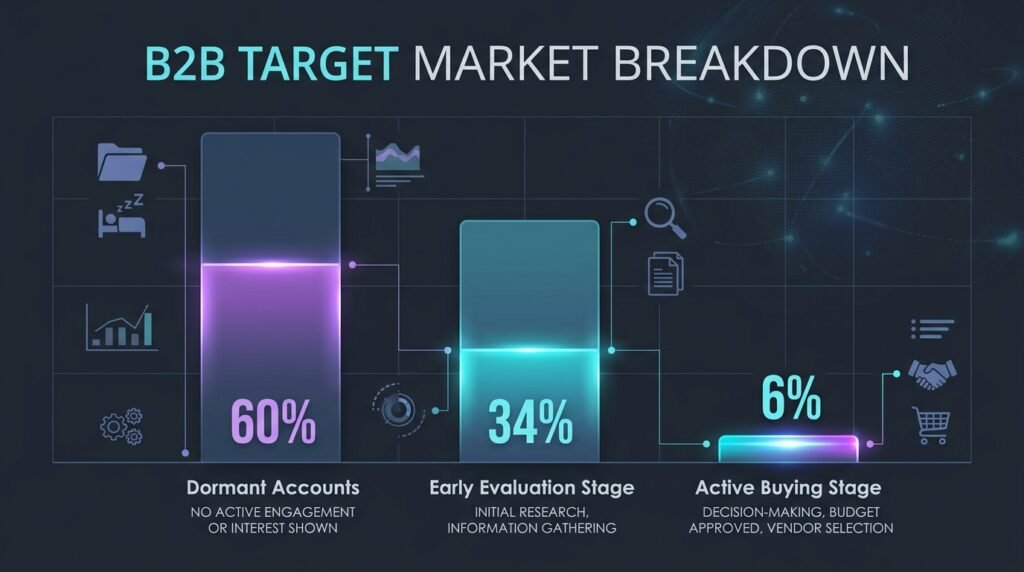
- Market Reality vs. Resource Split: Research from the 6sense B2B Buyer Experience Study demonstrates dynamic account states (~60% dormant/target accounts, ~34% early/mid-stage evaluation, ~6% late-stage buying). Market buyer distribution must never be confused with marketing budget allocation.
- The Multiplicative Engine Model: We structure the demand engine as a 4-variable operating heuristic: $\text{Demand Creation} \times \text{Signal Routing} \times \text{Demand Capture} \times \text{Buyer Enablement}$. If any single component is severely neglected, overall pipeline output can deteriorate sharply.
- Cross-Functional Execution: True scaling requires explicit functional ownership across Content/Brand (Creation), RevOps (Signal Routing), Growth/SEO (Capture), and Sales/AEs (Buyer Enablement), supported by modern intent and demo infrastructure.
SaaS Demand Generation at a Glance
| Strategic Dimension | Legacy Lead Generation Engine | Modern Demand Generation Operating Engine |
| Primary Output | High MQL Volume (Low Intent) | High-Intent Qualified Pipeline (SQOs) |
| Content Mechanics | Gated Whitepapers & Lead Forms | Open-Access Teardowns, Interactive Demos, & Frameworks |
| Buyer Journey Mechanics | Rep-Forced Gatekeeping | Self-Guided Research + Contextual Rep Consulting |
| Data & Routing | Form Fills $\rightarrow$ SDR Cold Calls | First-Party Intent Signals $\rightarrow$ Account-Level Routing |
| Measurement Focus | Software-Only Last-Touch Models | Hybrid Models (Software Data + Self-Reported Feedback) |
The Shift: Why SaaS Demand Generation Replaces Legacy Lead Gen
Most B2B SaaS companies suffer from a lead generation illusion. They lock generic eBooks behind multi-field forms, pass cold contacts to SDRs for aggressive outreach, and wonder why pipeline velocity stalls while Customer Acquisition Costs (CAC) escalate.
Data from the Gartner 2026 B2B Buyer Behavior Survey reveals that 67% of buyers prefer a representative-free purchasing experience, while 70% prefer a fully digital or self-service buying path. Furthermore, 45% of B2B buyers now leverage generative AI tools to evaluate vendor capabilities and compare technical specs prior to engaging vendor representatives.
💡 Practitioner Field Note (Before vs. After Scenario):
- Before: A Series-B DevSecOps platform spent $45,000/month driving paid traffic to a gated whitepaper. Result: 620 MQLs, 14 SDR discovery calls booked, and only 2 closed deals (CAC: ~$22,500).
- After: The team ungated the guide into interactive architecture teardowns, implemented first-party intent tracking on API docs, and added self-guided product tours. Result: Lower total form volume, but 38 high-intent demo requests directly from target accounts and 9 closed deals within 90 days (CAC dropped to ~$7,800).
To scale predictably, growth-stage software platforms must transition from friction-heavy lead capture to an operational SaaS Demand Generation Engine—a system engineered to educate out-of-market accounts continuously and convert active buyers seamlessly.
Deconstructing Market Timing: 95/5 Heuristic vs. Account Distribution
The foundational concept driving modern B2B marketing strategy is the 95/5 Rule (originally articulated as a market timing heuristic by Professor John Dawes at the Ehrenberg-Bass Institute for Marketing Science). It dictates that at any given time, roughly 95% of target accounts are out-of-market for a product, while only 5% are actively buying.
The Strategic Relationship: Why 95/5 Needs the Demand Engine
┌────────────────────────────────────────────────────────────────────────┐
│                        B2B Target Market State                         │
├───────────────────────────┬────────────────────────────────────────────┤
│ Dormant / Target Accounts │           Active Buying Journey            │
│ (~60% No Active Research) │ (~34% Early Evaluation | ~6% Late Buying)  │
└───────────────────────────┴────────────────────────────────────────────┘
- The “Why” (95/5 Market Reality): Explains why brand building, ungated content, and long-term mental availability matter. If 95% of buyers aren’t buying today, cold pitching them only creates brand fatigue.
- The “How” (The SaaS Demand Engine): Operationalizes this reality into daily execution—building brand preference among the 95% while harvesting intent seamlessly from the 5%.
Applying this concept in 2026 requires two critical nuances:
1. Market Distribution is Fluid, Not Binary
Research from the 6sense B2B Buyer Experience Study (analyzing 594 B2B organizations) shows that B2B accounts move through dynamic stages rather than sitting in a rigid binary split:
- ~60% Dormant / Target Accounts: Accounts displaying no active goal-oriented research or intent signals.
- ~34% Early/Mid-Stage Evaluation: Accounts actively researching operational bottlenecks, comparing software capabilities, or reviewing API docs without filling out forms.
- ~6% Late Buying Stage: Accounts displaying high-intent behaviors (pricing page reviews, product comparison sessions, vendor shortlisting).
2. Market Buyer Distribution $\neq$ Marketing Budget Allocation
A common strategic error is assuming that because 95% of buyers are out-of-market, a company must allocate exactly 95% of its budget to top-of-funnel brand building.
- Buyer Distribution measures where target accounts sit in their purchasing timeline.
- Resource Allocation describes how marketing teams balance short-term demand capture against long-term demand creation based on company stage, category maturity, and runway.
The Core Framework: Building a SaaS Demand Generation Engine
To operationalize this strategy, we model the SaaS Demand Engine as a multiplicative framework:
$$\text{SaaS Demand Engine} = \text{Demand Creation} \times \text{Signal Routing} \times \text{Demand Capture} \times \text{Buyer Enablement}$$
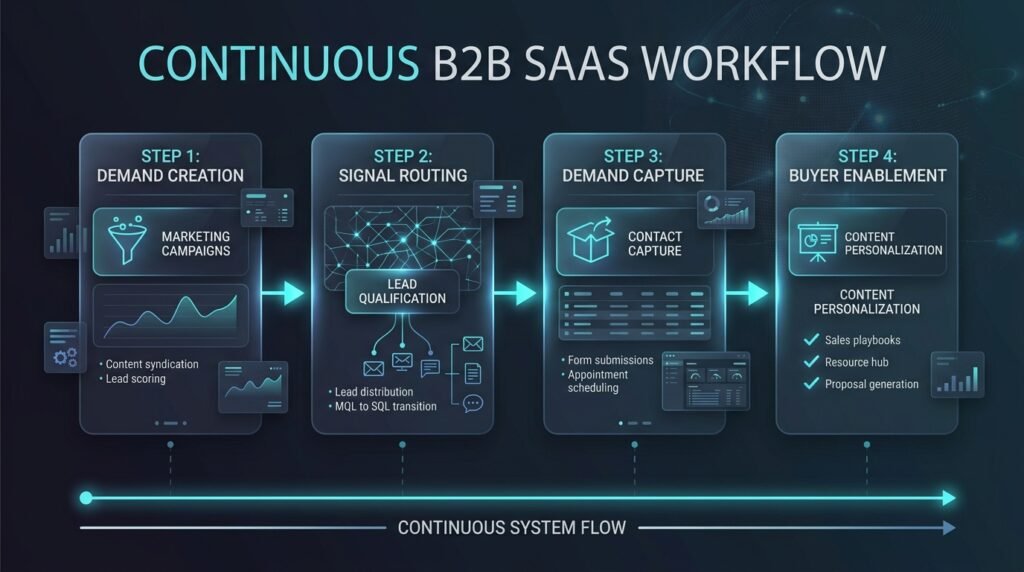
Under this operating model, if any single variable is severely neglected or absent, overall pipeline performance can deteriorate sharply.
Systematic Failure Modes: What Breaks When a Variable Fails?
| Neglected Variable | Operating Symptom | Primary Revenue Impact & Real-World Example |
| Weak Demand Creation | Relying exclusively on paid search ads and retargeting without building brand affinity. | Bidding costs escalate, CAC skyrockets, and pipeline stalls once keyword search volume is exhausted. |
| Weak Signal Routing | Generating high media engagement but failing to detect account-level intent. | Sales teams remain blind to active accounts; target accounts visit anonymously and exit to competitors. |
| Weak Demand Capture | Producing great content on social channels but maintaining broken SEO, high form friction, or poor mobile UX. | Accounts get educated by your content but convert on competitor sites with smoother demo paths. |
| Weak Buyer Enablement | Capturing demo requests but subjecting buyers to forced 30-minute SDR qualification calls before showing the software. | High demo drop-off rates ($>40\%$ drop-off between form fill and completed demo), extended sales cycles, and reduced win rates. |
Execution Framework by Company Stage
Demand generation priorities must adapt to company maturity and resource availability:
Executing a SaaS demand generation strategy requires adjusting priorities based on company maturity and available runway.
| Stage | Primary Objective | Creation Focus | Capture Focus | Sales Motion & Enablement |
| Early-Stage | Validate repeatable positioning & messaging | Founder-led content, niche podcasts, direct SME breakdown posts | High-intent search terms ([Category] software), basic demo forms | Founder / AE direct discovery & live interactive walkthroughs |
| Growth-Stage | Scale pipeline velocity & capture category demand | Systematic thought leadership, ungated teardowns, video series | Programmatic SEO, competitor alternative pages, retargeting | AE-led contextual demos, automated calendar booking, custom ROI tools |
| Enterprise | Expand account coverage & defend category leadership | Account-Based Marketing (ABM), original research reports, executive dinners | Multi-channel capture, branded intent monitoring, custom review portals | Multi-threaded buying committee enablement, dedicated Solutions Engineers |
Demand Engine Ownership Matrix
To prevent internal silos, every component of the demand engine must have explicit functional ownership:
| Operating Variable | Functional Owner (Lead) | Cross-Functional Support | Technology Stack | Core Metric |
| Demand Creation | Content / Brand Lead | SMEs, Product Marketing | LinkedIn, YouTube, Podcast Platforms, Ungated CMS | Engaged Target Account Growth |
| Signal Detection | RevOps / Marketing Ops | Data Analytics, Growth | Intent Platforms (6sense/Koala), IP Intelligence | Account Intent Spikes Triggered |
| Demand Capture | Growth / SEO Lead | Paid Media, Web Dev | Search Console, Retargeting, Conversion Routing | High-Intent Form Submissions |
| Buyer Enablement | Sales / AE Lead | Product Marketing, Pre-Sales | Interactive Demos (Navattic/HowdyGo), Scheduling Tools | Discovery-to-SQO Conversion Rate |
Channel Matrix: Execution by Intent Depth Tier
Intent Depth Tier: [0% - 25% Low] ────────► [25% - 50% Moderate] ────────► [50% - 100% High]
Execution Method:  Dark Social & Media     Interactive Walkthroughs        Frictionless Booking & SEO
📌 Note: The percentages and thresholds below represent illustrative operating defaults for structuring campaign tactics, not universal industry standards.
1. Low-Intent Tier (0% – 25%): Demand Creation
- Primary Channels: Native LinkedIn breakdown posts, industry podcast guesting, sub-Reddit participation, ungated framework articles.
- Execution Rule: Deliver complete value natively within the feed (“Zero-Click Content”). Do not force users to click out to external landing pages to extract value.
2. Moderate-Intent Tier (25% – 50%): Account Engagement
- Primary Channels: Self-guided interactive product tours, open utility calculators, API documentation.
- Execution Rule: Allow buyers to experience core product workflows and UI before requiring contact details or discovery meetings.
3. High-Intent Tier (50% – 100%): Demand Capture
- Primary Channels: High-intent search engine optimization (
[Category] software,[Competitor] alternatives), intent retargeting, direct demo booking. - Execution Rule: Eliminate multi-field form gates. Provide instant calendar scheduling options immediately following basic qualification inputs.
Buyer Enablement: Product Proof, Social Proof & AI-Era Risk Reduction
Providing basic product access is only the first step in modern buyer enablement; closing enterprise pipeline in an AI-informed buyer environment requires systematic risk reduction:
Modern SaaS demand generation relies on product proof and interactive demos to reduce buying risk before sales engagement
Buyer Progression: Open Education ──► Product Proof ──► Social Proof ──► Decision Support
How AI Buyer Search Changes Demand Enablement in 2026
With nearly half of B2B buyers using LLM agents and AI search tools to draft vendor comparisons, B2B brands must ensure their product capabilities, pricing structures, and integration specs are structured openly across their web properties. If key product information is hidden behind sales-rep or form gates, AI-assisted research systems may have less accessible information from which to understand and evaluate your offering.
The 3 Layers of Decision Support
- Product Proof (Interactive Access): Embed self-guided interactive tours directly on key product pages so buyers and AI evaluation tools can analyze workflows independently.
- Social Proof (Contextual Peer Evidence): Replace generic logo walls with detailed customer teardowns showing specific metrics, technical setup environments, and implementation timelines.
- Decision Support (Internal Champion Tools): Supply buyers with internal business cases, vendor comparison matrixes, and security/compliance documentation to help them sell the platform internally to CFOs and buying committees.
Commercial & Operational Infrastructure: Tech Stack, Budgeting & Agency Selection
To execute this model predictably, revenue leaders must align technical tooling and capital allocation with organizational stage.
1. The Modern SaaS Demand Tech Stack
A high-performing demand engine requires four synchronized technology layers:
┌────────────────────────────────────────────────────────────────────────┐
│                        SaaS Demand Technology Stack                   │
├───────────────────┬───────────────────┬───────────────┬────────────────┤
│ First-Party Intent│ Interactive Demos │ Routing/Book  │ Attribution    │
│ (Koala, 6sense)   │ (Navattic,        │ (Chili Piper, │ (HockeyStack,  │
│                   │  HowdyGo)         │  Cal.com)     │  Dreamdata)    │
└───────────────────┴───────────────────┴───────────────┴────────────────┘
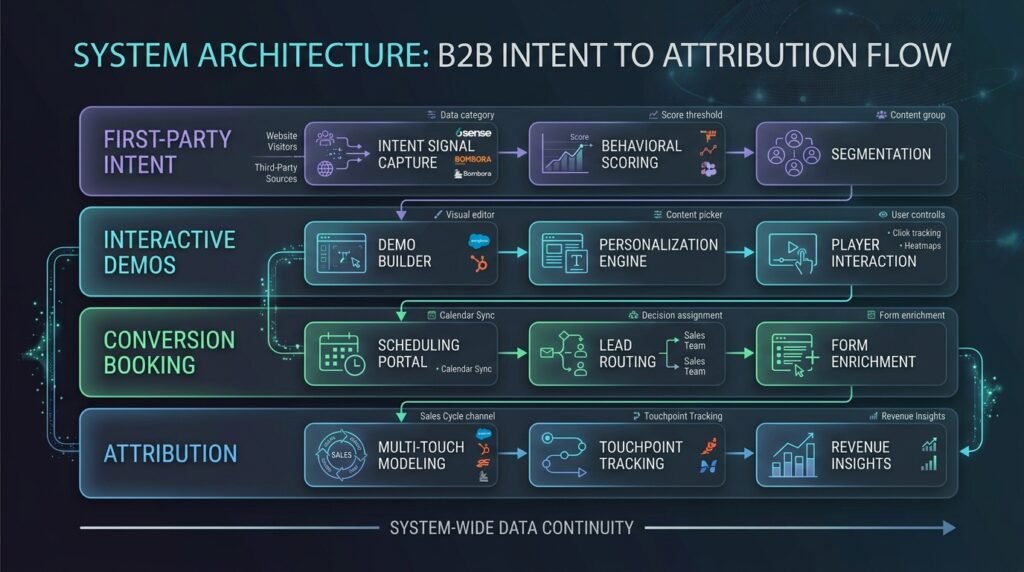
- Signal & Intent Layer:Koala, 6sense, Clearbit (detects anonymous target account visits and triggers RevOps alerts).
- Interactive Buyer Enablement Layer:Navattic, HowdyGo, Arcade (builds self-guided product tours embedded on website landing pages).
- Conversion & Scheduling Layer:Chili Piper, Cal.com (routes qualified leads directly to AE calendars post-submission).
- Hybrid Attribution Layer:HockeyStack, Dreamdata (combines CRM digital touchpoints with self-reported attribution data).
2. Capital & Budget Allocation Benchmarks
Budget splits vary by ARR maturity and market category:
| Company ARR Tier | Demand Creation (Brand/Media) | Demand Capture (SEO/Paid Search) | Buyer Enablement & Ops |
| $1M – $5M ARR | 30% – 40% | 50% – 60% | 10% |
| $5M – $20M ARR | 45% – 55% | 35% – 45% | 10% – 15% |
| $20M+ ARR | 55% – 65% | 25% – 35% | 15% – 20% |
3. Agency vs. In-House Execution Matrix
Decision Pivot: [Early Velocity/Setup] ──► Partner Agency
                [Core Brand Voice/AEs] ──► In-House Ownership
| Decision Criteria | In-House Demand Team | Specialized Demand Agency |
| Best Used For | Core brand voice, subject matter expertise, direct sales alignment | Rapid infrastructure setup, specialized SEO/paid distribution, creative production |
| Cost Dynamics | High fixed overhead (Salaries + Benefits for full-stack team: $350k–$600k/yr) | Predictable monthly retainer ($8k–$20k/month); scalable by performance scope |
| Time to Ramp | 3–6 months (Recruiting, onboarding, alignment) | 2–4 weeks (Pre-built playbooks & tech stack integrations) |
| Recommended Hybrid Model | Retain Strategic Direction, Product Marketing, and AE Enablement in-house; partner with agencies for Technical SEO, Programmatic Paid Media, and Creative Scaling. |
4-Step Execution Playbook for SaaS Operators
Step 1: Define Precise ICP & Signal Triggers
Establish firmographic parameters (revenue brackets, headcount tiers, tech stack dependencies) alongside trigger events (e.g., key leadership changes, recent funding rounds, tech stack migrations).
Step 2: Publish Ungated Product-Led Content
Eliminate forms on educational whitepapers and guides. Publish complete playbooks directly on your blog or social channels, and embed interactive product walkthroughs into high-intent landing pages.
Step 3: Implement Signal-Driven Intent Harvesting
Configure automated intent alerts within your CRM or RevOps platform. Example trigger thresholds include:
- Pricing Page Multi-Visits:$\ge 2$ unique visitors from a single target domain reviewing pricing within a 7-day window.
- Comparison Engagement: An account spending $> 3$ minutes analyzing a
[Your Brand] vs [Competitor]comparison page. - Technical Documentation Sessions: An account actively reviewing API, security, or integration documentation.
When these thresholds are breached, trigger context-aware outreach from an account executive tailored to the specific pages viewed.
Step 4: Streamline High-Intent Conversion Paths
Keep forms to the minimum fields needed for qualification; for many SaaS demo flows, that may be around 3–4 essential fields (e.g., Work Email, Name, Company Size). Validate inputs in real time and display an embedded calendar widget to let qualified prospects schedule a discovery call immediately.
Core Metrics to Measure Demand Engine Health
$$\text{Pipeline Velocity} = \frac{\text{Active SQOs} \times \text{Average Deal Size} \times \text{Win Rate}}{\text{Sales Cycle Length (Days)}}$$
$$\text{Pipeline Coverage} = \frac{\text{Qualified Pipeline Value}}{\text{Quarterly Revenue Target}}$$
- Qualified Pipeline Value (SQOs): Total contract value of Sales Qualified Opportunities generated during the period.
- Pipeline Coverage Ratio: Total qualified pipeline divided by revenue targets. A common planning baseline is around $3\times$ to $4\times$, though exact targets depend on historical win rates, average deal size, and sales cycle duration.
- CAC Payback Period: Months required for gross profit to recover the total acquisition expenditure.
- Pipeline Velocity: The daily financial value moving through your sales pipeline.
- Self-Reported Attribution: Qualitative feedback gathered via an open input field on booking forms: “How did you first hear about us?”
Frequently Asked Questions (FAQs)
SaaS demand generation is an overarching GTM strategy focused on category education, account preference, and qualified pipeline creation. Growth marketing focuses on rapid, experiment-driven loops across the entire funnel, including user activation, retention, viral loops, and monetization.
Timelines vary based on domain authority, market demand, and sales cycle length. High-intent capture programs (SEO, search ads) can begin producing measurable pipeline within 60–90 days, while demand creation initiatives (thought leadership, media distribution) typically require 6 to 12 months to generate compounding pipeline velocity.
Should an early-stage SaaS startup hire an agency or build in-house?
Early-stage startups often partner with specialized demand generation agencies to establish tracking systems, run initial paid distribution, and set up SEO structures without adding heavy headcount overhead. Growth-stage companies usually transition to a hybrid model—retaining strategic positioning, brand voice, and sales enablement in-house while outsourcing tactical execution mechanics.
👤 About the Author & Editorial Methodology
Written by Muhammad Talha Saeed
SaaS Content Strategist & SEO Architect at AISAASWRITER.COM
Editorial Research & Synthesis Methodology:
This operating framework was developed by analyzing published B2B purchasing research (including the Gartner 2026 B2B Buyer Behavior Survey, 6sense B2B Buyer Experience Study, and research from the Ehrenberg-Bass Institute) alongside hands-on GTM execution experience in B2B software marketing. Content and frameworks are updated regularly to maintain technical accuracy and alignment with modern search indexation standards.