

Introduction
Choosing the right online marketplace can have a direct impact on your business growth, sales performance, and profitability. Today, businesses can choose from multiple platforms, including Amazon, Etsy, eBay, Walmart Marketplace, Shopify, and specialized industry marketplaces. However, having many options creates one major challenge: how to choose the right marketplace for your business.
The biggest marketplace is not always the best choice. A platform with millions of users may not generate results if your target customers are not active there, competition is too high, or marketplace costs reduce your profits.
The right marketplace should match your product, customers, budget, business model, and long-term growth goals.
This guide explains a practical framework businesses can use to evaluate marketplaces, compare platforms, and make smarter decisions using data and modern SaaS tools.
Quick Answer: How to Choose the Right Marketplace for Your Business?
To choose the right marketplace, evaluate these five factors:
- Target audience – Choose a platform where your ideal customers already shop.
- Product-marketplace fit – Make sure your products match the platform’s audience.
- Profitability – Calculate fees, advertising costs, shipping, and margins.
- Competition level – Understand whether you can realistically compete.
- Growth potential – Select a marketplace that supports scaling and automation.
The best marketplace is not necessarily the largest one. It is the platform that provides the strongest match between your customers, products, and business objectives.
Key Takeaways
- Select marketplaces based on customer fit instead of popularity alone.
- Analyze complete costs before choosing a platform.
- Different products perform better on different marketplaces.
- Competition research helps identify realistic opportunities.
- AI and SaaS tools can improve marketplace research and decision-making.
What Is an Online Marketplace?
An online marketplace is a digital platform where multiple sellers connect with customers through a shared online ecosystem.
The marketplace provider usually manages:
- Customer traffic
- Payment processing
- Seller tools
- Product discovery
- Platform infrastructure
Examples of popular marketplaces include:
- Amazon Marketplace
- Etsy
- eBay
- Walmart Marketplace
- Shopify-based ecommerce platforms
Marketplaces help businesses access customers faster, but success depends on choosing the platform that matches your business needs.
Marketplace vs Your Own Website: Which Is Better?
Businesses often decide between selling through marketplaces or building their own ecommerce website.
| Online Marketplace | Own Website |
|---|---|
| Existing customer traffic | Full brand ownership |
| Faster customer acquisition | Requires marketing efforts |
| Built-in trust | Complete control |
| Platform fees | More responsibility |
Many successful businesses use a hybrid strategy:
- Marketplaces for customer acquisition
- Their own website for brand building and customer relationships
How to Choose the Right Marketplace for Your Business
1. Understand Your Target Customers
The first step is understanding where your customers already shop.
Analyze:
- Customer demographics
- Buying behavior
- Search patterns
- Purchasing preferences
Ask yourself:
- Who is my ideal customer?
- Which platforms do they trust?
- Where do they search for products like mine?
For example:
A customer searching for handmade decorations may prefer Etsy, while someone buying electronics may start with Amazon.
The best marketplace is where your customers already have buying intent.
2. Match Your Product With the Marketplace Audience
Every marketplace attracts a different type of customer.
Before choosing a platform, evaluate:
- Product category
- Customer expectations
- Demand level
- Competition
Examples:
Handmade Products
Platforms focused on unique and creative products may provide better opportunities.
Mass-Market Products
Large retail marketplaces can provide access to wider audiences.
Brand-Focused Businesses
Businesses that want complete control may benefit from platforms that support brand ownership.
The key question:
Does this marketplace attract customers who are already interested in my product?
3. Analyze Marketplace Fees and Profitability
Many businesses focus only on sales volume and ignore profitability.
Before selecting a marketplace, calculate:
Selling Price – Product Cost – Marketplace Fees – Advertising Cost – Shipping Cost = Actual Profit
Consider:
- Commission fees
- Listing charges
- Subscription costs
- Fulfillment expenses
- Return costs
- Advertising expenses
A marketplace with millions of visitors may not be valuable if the cost of selling becomes too high.
4. Research Competition Before Joining
Competition analysis helps businesses understand whether they can succeed.
Evaluate:
- Number of similar sellers
- Competitor pricing
- Product reviews
- Customer expectations
- Advertising competition
A highly competitive marketplace may require:
- Strong branding
- Better pricing
- Unique products
- Better customer experience
5. Evaluate Marketplace Features and Technology
Modern businesses should consider more than just traffic.
Important marketplace features include:
- Sales analytics
- Inventory management
- Marketing tools
- Customer insights
- API integrations
- Automation options
Technology becomes increasingly important as businesses scale.
Popular Online Marketplaces Compared
| Marketplace | Best For | Main Advantage | Challenge |
|---|---|---|---|
| Amazon | Mass-market products | Large customer base | High competition |
| Etsy | Handmade and creative products | Niche buyers | Limited categories |
| eBay | Different product categories | Flexible selling | Price competition |
| Shopify | Brand-focused businesses | Full control | Requires marketing |
| Walmart Marketplace | Retail sellers | Established customer base | Seller requirements |
The right choice depends on your business strategy, not simply marketplace size.
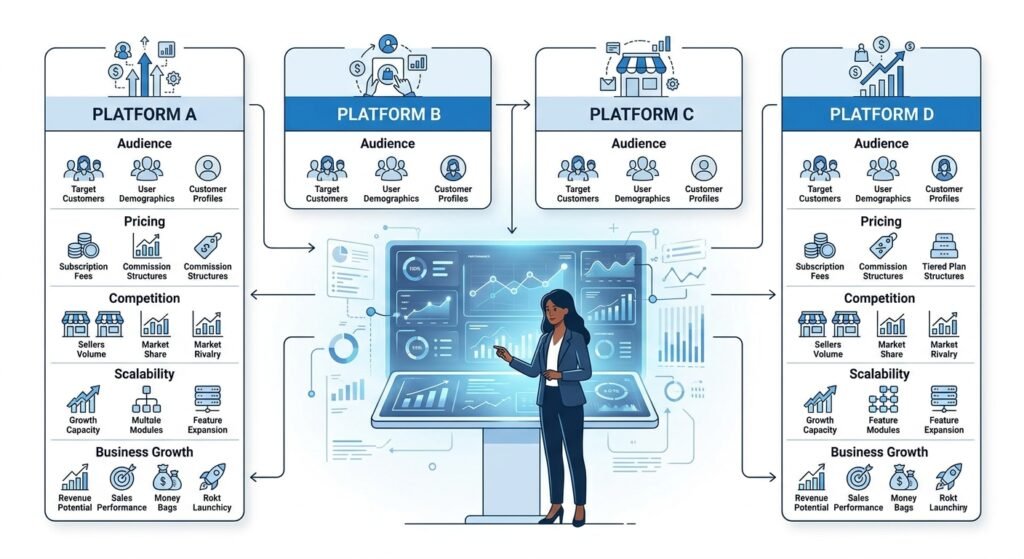
Marketplace Selection Scorecard
A simple evaluation framework can help compare different platforms.
Score each marketplace from 1–5:
| Factor | Score |
|---|---|
| Customer Match | /5 |
| Product Fit | /5 |
| Profit Potential | /5 |
| Competition Level | /5 |
| Growth Opportunities | /5 |
| Technology & Automation | /5 |
The marketplace with the highest total score is usually the strongest option for your business.
Best Marketplace Choice Based on Business Type
Small Businesses
Focus on:
- Easy setup
- Affordable selling costs
- Access to relevant customers
Ecommerce Brands
Prioritize:
- Customer reach
- Advertising options
- Scalability
- Analytics tools
Handmade Sellers
Look for:
- Niche communities
- Product discovery
- Creative audiences
SaaS Companies
Software businesses should evaluate:
- App marketplaces
- Software directories
- Partner ecosystems
Examples:
- Shopify App Store
- AWS Marketplace
- Salesforce AppExchange
For SaaS businesses, the right marketplace is often where potential users actively search for software solutions.
How AI Tools Help Businesses Choose the Right Marketplace
AI-powered SaaS tools are changing how businesses research ecommerce opportunities.
AI Market Research
AI can analyze:
- Customer trends
- Product demand
- Market opportunities
Competitor Analysis
Businesses can use software tools to understand:
- Competitor pricing
- Product positioning
- Customer feedback
- Market gaps

Sales Forecasting
AI analytics can help businesses identify:
- Demand patterns
- Inventory requirements
- Revenue opportunities
Keyword and Customer Research
AI tools can analyze:
- Search trends
- Customer interests
- Product opportunities
This allows businesses to make decisions based on data instead of assumptions.
Common Mistakes Businesses Make When Choosing a Marketplace
1. Choosing Only Based on Traffic
A large audience does not guarantee success.
Customer relevance matters more than visitor numbers.
2. Ignoring Total Costs
Businesses often underestimate:
- Platform fees
- Advertising expenses
- Shipping costs
- Returns
Always calculate actual profit.
3. Joining Too Many Marketplaces Too Early
Managing multiple platforms requires:
- Inventory systems
- Customer support processes
- Automation workflows
Start with one suitable marketplace and expand gradually.
4. Not Using Analytics
Successful businesses track:
- Sales performance
- Conversion rates
- Customer behavior
- Profit margins
Data helps improve marketplace decisions.
Future of Marketplace Selling: AI and Automation
The future of marketplace selling will increasingly depend on technology.
Businesses are adopting:
- AI-powered recommendations
- Automated inventory systems
- Smart pricing tools
- Predictive analytics
- Customer behavior analysis
Companies that combine marketplace strategies with SaaS solutions can improve efficiency and make faster decisions.
Frequently Asked Questions
Consider your target audience, product category, marketplace fees, competition, profitability, technology features, and future growth opportunities.
No. Amazon works well for many businesses, but the best marketplace depends on your products, customers, competition, and goals.
What is the best marketplace for small businesses?
The best option depends on the business type. Small businesses should compare customer fit, costs, competition, and growth opportunities before choosing.
Businesses can expand to multiple marketplaces after creating strong systems for inventory management, customer support, and analytics.
Can AI help businesses choose a marketplace?
Yes. AI tools can analyze customer behavior, competitors, keywords, and market trends to support better marketplace decisions.
About the Author
AISaaSWriter Research Team
AISaaSWriter creates research-based content about SaaS, artificial intelligence, ecommerce technology, and digital business strategies.
Our goal is to help businesses understand modern software solutions and apply technology-driven approaches for growth.
Final Thoughts
Choosing the right marketplace is a strategic decision that can influence your business success.
Instead of selecting a platform only because it is popular, evaluate customer fit, profitability, competition, technology, and scalability.
A marketplace that aligns with your business goals can become a powerful channel for sustainable growth.