
By: Muhammad Talha Saeed — Enterprise Search & B2B Ecommerce Technology Specialist
Reviewed and Updated: September 2026
B2B search is a technology that helps businesses find products, suppliers, companies, and important business information quickly. Unlike traditional search engines, B2B search systems are designed for complex business catalogs, technical specifications, enterprise databases, and professional buying processes.
Modern B2B search combines keyword search, AI-powered semantic search, and machine learning to deliver accurate results for manufacturers, distributors, ecommerce platforms, and enterprise organizations.
What Does B2B Search Mean?
B2B search refers to the process businesses use to find products, companies, suppliers, customers, and business information through specialized search systems. Unlike regular search, B2B search focuses on complex business data, technical specifications, product catalogs, and professional buying requirements.
Types of B2B Search
B2B search can be divided into several categories depending on business requirements:
B2B Product Search
Used by manufacturers and distributors to help buyers find products, SKUs, specifications, and technical documents.
B2B Company Search
Helps sales teams discover companies, suppliers, and potential business customers.
Enterprise Search
Allows organizations to search internal documents, databases, and business information.
AI-Powered B2B Search
Uses machine learning and semantic search to understand user intent and deliver relevant results.
B2B Search vs. B2C Search: Key Differences
While consumer (B2C) search prioritizes visual merchandising and impulse buying triggers, enterprise B2B search operates under strict operational and technical constraints.
| Operational Feature | B2B Search Engine | B2C Search Engine |
| Catalog Complexity | Highly structured, deep parent-child SKU hierarchies, multi-level variations. | Flat or shallow category structures with standard variants (color/size). |
| Query Types | Exact part numbers, OEM codes, legacy SKUs, technical attributes (e.g., 200 PSI 2-inch valve). | Broad natural language, brand names, visual trend terms (e.g., red running shoes). |
| Pricing Models | Dynamic, account-specific contract pricing, tier-based volume discounts. | Uniform, public list pricing. |
| User Access Control | Account entitlements, buyer permissions, localized regional visibility. | Universal catalog visibility for all site visitors. |
| Unit Conversions | Automatic Unit of Measure (UOM) conversion (e.g., box vs. pallet vs. metric/imperial). | Standard single-unit sales. |
| Indexed Assets | Products, PDF technical specification sheets, CAD drawings, MSDS files, manuals. | Standard product detail pages (PDP) and blog articles. |
| Buyer Intent | High intent, task-oriented, repeat purchasing, specification matching. | Exploratory browsing, price comparison, trend discovery. |
The Business ROI of Modern B2B Search
Upgrading from legacy keyword search to a modern enterprise B2B discovery platform delivers measurable commercial impacts across the organization:
- Conversion Rate Lift: For instance, industry benchmarks show that B2B buyers using site search convert at 3x to 5x higher rates than users relying solely on navigation menus.
- Reduction in Search Exits: In addition, modern semantic and zero-result recovery pipelines lower search abandonment rates by 25% to 40%.
- Decreased Support Ticket Volume: Furthermore, indexing PDF manuals and CAD files allows engineers to self-serve, which directly cuts customer support calls regarding part compatibility by up to 30%.
- Increased Average Order Value (AOV): As a result, automated AI cross-sell and substitute recommendations present compatible replacement parts directly within search results to drive higher basket sizes.
Technical Architecture: How B2B Search Engines Work
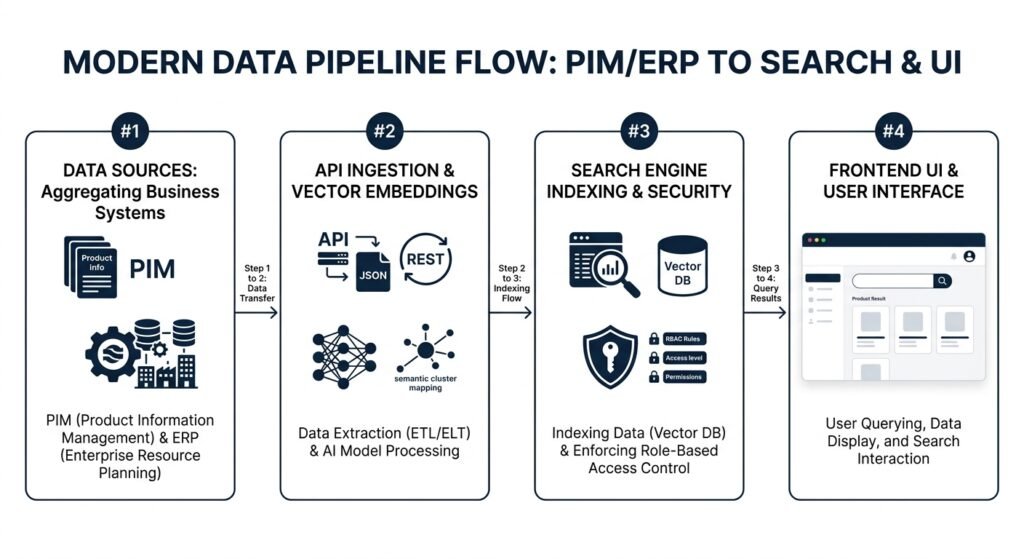
A robust B2B search architecture relies on four interconnected operational layers that process data from ingestion to presentation.
1. Data Ingestion & Systems Sync
First, enterprise search engines maintain active data pipelines connected to core business systems via REST APIs and Webhooks:
- Product Information Management (PIM): Supplies rich attributes, technical taxonomy, and localized specs.
- Enterprise Resource Planning (ERP): Provides real-time regional inventory status, warehouse locations, and customer pricing tables.
- Content Management Systems (CMS): Feeds technical documentation, installation guides, and compliance PDFs into the index.
Practitioner Insight: However, indexing contract prices directly in the search index can create massive index bloat if you have thousands of accounts with custom price books. Therefore, the most scalable architecture uses a hybrid indexing model: index baseline list prices for faceting, and execute an asynchronous API lookup to the ERP to render exact contract prices at query time.
2. Query Processing & Entity Extraction
Next, when a user submits a search query like “316 SS hydraulic valve 2 in 200 PSI”, the processing pipeline breaks it down into explicit technical attributes:
- Material: 316 Stainless Steel
- Category: Hydraulic Valve
- Size Attribute: 2 inches
- Pressure Rating: 200 PSI
3. Entitlement & Contract Rules Engine
Furthermore, before results are generated, the engine applies user-level and account-level security filters:
- Role-Based Access Control (RBAC): Ensures junior buyers only see approved purchasing lists.
- Regional Entitlements: Excludes products that cannot be shipped to or sold in the buyer’s geographical territory.
4. Search Ranking & Commercial Merchandising
Finally, overall ranking combines search relevance scores with real-world business logic:
- In-stock inventory prioritized over backordered items.
- High-margin or strategic vendor products boosted appropriately.
- Personalization based on the buyer’s past purchase history and equipment profile.
Best B2B Search Tools and Platforms
Businesses use different B2B search platforms depending on catalog size, ecommerce requirements, and AI capabilities.
| Tool | Best For |
|---|---|
| Elasticsearch | Enterprise custom search |
| Algolia | Ecommerce search |
| Coveo | AI enterprise search |
| Bloomreach | Digital commerce |
| Constructor | Product discovery |
Search Retrieval Technologies: From Lexical to Vector & RAG
Modern enterprise discovery engines rely on multiple retrieval paradigms working in tandem to balance accuracy with context awareness.
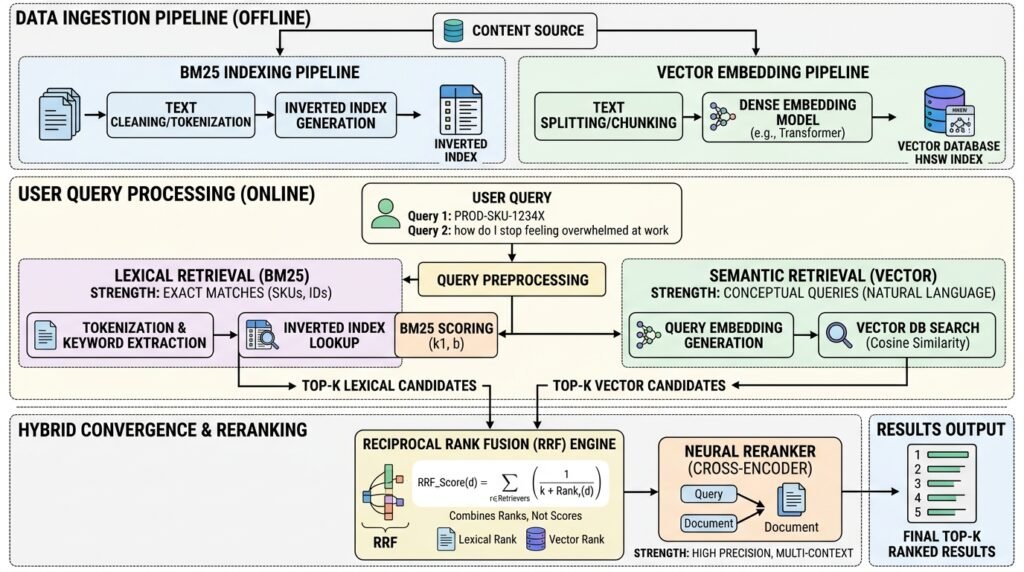
Lexical Search (Keyword & Exact Match)
- How it works: Uses inverted indexes and algorithms like BM25 to match precise character strings.
- Best for: Part numbers, SKUs, model codes, and exact brand names (e.g., SKF 6205-2RSH).
- Limitation: Fails when buyers use natural language synonyms or misspellings not pre-defined in a dictionary.
Semantic & Vector Search (Dense Retrieval)
- How it works: Converts text, attributes, and search queries into digital math patterns (vectors) using smart AI models.
- Best for: Natural language queries where exact keywords may not exist in the database (for example, searching “food grade pump for thick liquids” retrieves sanitary positive displacement pumps).
- Limitation: However, it can sometimes struggle with exact part numbers if vector calculations override exact keyword matches.
Hybrid Search (The Modern Standard)
Hybrid search combines lexical and vector search pipelines using Reciprocal Rank Fusion (RRF) algorithms. Consequently, it delivers exact keyword accuracy for part numbers while leveraging semantic capabilities for exploratory queries.
Retrieval-Augmented Generation (RAG) & Conversational Search
For enterprise industrial applications, modern B2B search engines deploy Retrieval-Augmented Generation (RAG). When an engineer asks a complex technical question:
“What is the maximum operating temperature for a Fluorosilicone O-ring in a hydraulic system?”
The RAG engine retrieves relevant passages directly from indexed PDF specification sheets, parses the engineering data, and constructs a clear, direct answer accompanied by explicit citations and purchase links for compatible replacement parts.
Essential Features of a High-Performing B2B Search System
To handle enterprise product catalogs effectively, your B2B search platform must support several specialized features:
1. Advanced Part Number & Cross-Reference Recognition
Industrial buyers frequently search using competitor part numbers, legacy internal codes, or fragmented manufacturer numbers. Therefore, a mature B2B search engine must feature:
- Format-Agnostic Matching: Recognizing
ABC-1234-XYZ,ABC1234XYZ, andABC 1234 XYZas identical items. - Cross-Reference Mapping: Mapping a discontinued manufacturer’s part number to a direct in-stock equivalent.
2. Unit of Measure (UOM) & Metric/Imperial Auto-Conversion
B2B catalogs often mix measurement standards. Therefore, an enterprise search engine should automatically normalize queries across systems:
- For instance, entering “1/2 inch bolt” automatically returns items indexed as “12.7 mm bolt”.
- Similarly, querying “50 lb bag” recognizes equivalent metric packaging variants.
- In addition, searching by metric units will display matching imperial alternatives.
3. Technical Faceting & Attribute Filtering
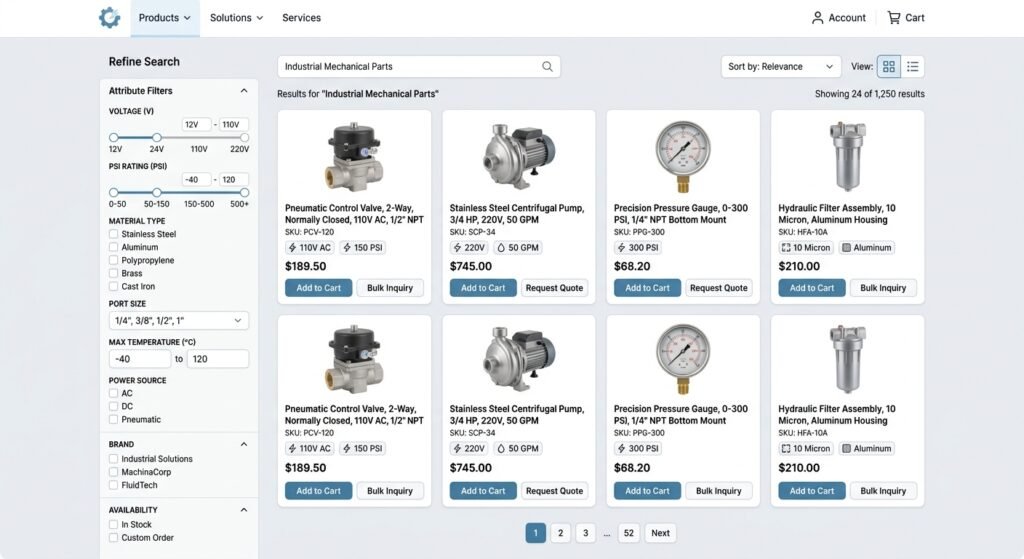
B2B buyers rely on precise technical filters rather than standard retail categories. As a result, the search UI must dynamically display context-aware facets based on the query:
- Query: “Electric Motors” -> Facets: Horsepower, Frame Size, Enclosure Type, Voltage, RPM.
- Query: “Fasteners” -> Facets: Thread Size, Material, Head Style, Drive Type, Length.
4. Non-Product Document Indexing
Valuable information often resides outside the PIM database. Consequently, the engine must extract, OCR, index, and surface content from unstructured files:
- Operating Manuals and Field Guides
- CAD Drawings (
.DWG,.DXF,.STEP) - Material Safety Data Sheets (MSDS) & Compliance Certificates
5. Zero-Result Recovery Pipelines
When a search query yields no exact inventory matches, the system must prevent dead ends by:
- Suggesting direct functional substitutes based on vector proximity.
- Displaying alternative products matching key technical parameters.
- Offering an automated “Request a Quote” or “Contact Engineering Support” prompt pre-filled with query details.
Enterprise B2B Search Platform Comparison
Selecting the right vendor depends on your internal engineering resources, catalog size, integration architecture, and AI requirements.
| Platform | Target Segment | Core Strengths | AI / Vector Capability | Native PIM/ERP Connectors | Pricing Model |
| Elasticsearch / OpenSearch | Enterprise Custom Builds | Unlimited flexibility, open architecture, complete infrastructure control. | Native Vector database & ELSER sparse vector model. | Custom API development required. | Infrastructure resource-based (Open Source / Hosted Cloud). |
| Coveo | Mid-Market to Global Enterprise | Native B2B AI relevance, automatic personalization, deep enterprise integrations. | Advanced vector search, RAG, and neural reranking out of the box. | Broad enterprise connectors (Salesforce, SAP, Adobe). | Annual SaaS subscription based on query volume & index size. |
| Bloomreach | B2B & B2C Ecommerce | Merchandising tools, semantic understanding, digital commerce focus. | Loomi AI for semantic matching and automated discovery. | Strong connectors for major commerce platforms (commercetools, SAP). | Annual SaaS subscription based on GMV / usage. |
| Algolia | Developer-Led Ecommerce | Ultra-fast indexing, developer-friendly APIs, rapid implementation time. | NeuralSearch combining vector and keyword pipelines. | Extensible API framework with turnkey ecommerce plugins. | Consumption-based pricing (Records & Search Operations). |
| Constructor | Large Enterprise Commerce | Self-learning AI models focused purely on driving revenue metrics. | Fully automated transformer-based discovery models. | Pre-built integrations for headless enterprise frameworks. | Revenue-share or customized enterprise SaaS tier. |
Build vs. Buy: Selecting the Right Path
Enterprise technical leaders must weigh the strategic trade-offs between custom development and commercial SaaS platforms.
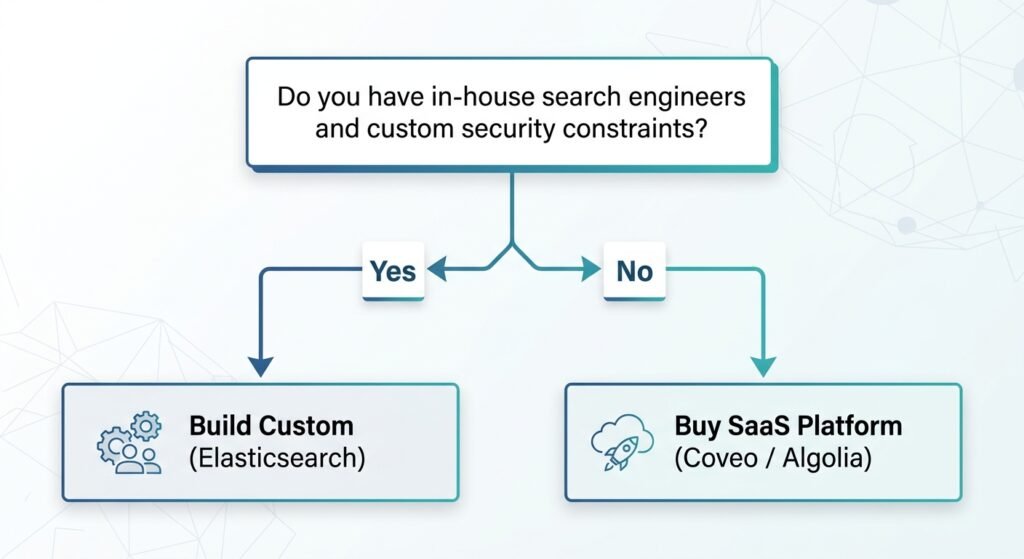
Option A: Building on Open Infrastructure (Elasticsearch / OpenSearch)
- Ideal for: Large enterprises with dedicated search engineering teams, complex proprietary security constraints, or unique custom workflows.
- Pros: Full ownership of algorithms, complete control over data privacy, and no per-query licensing fees.
- Cons: However, it incurs a high total cost of ownership (TCO) for maintenance and continuous tuning required to match commercial SaaS performance.
Option B: Deploying an Enterprise SaaS Platform (Coveo, Bloomreach, Algolia)
- Ideal for: Organizations seeking fast deployment, out-of-the-box AI capabilities, and intuitive business merchandising UIs for non-technical teams.
- Pros: Turnkey B2B capabilities, vendor-managed AI updates, built-in analytics, and lower initial development overhead.
- Cons: On the other hand, recurring software costs scale with catalog size and query volume, along with potential platform customization limits.
Step-by-Step Implementation Roadmap
A successful enterprise search deployment follows a structured four-phase process:
Step 1: Audit and Normalize Product Data Quality
First, search relevance is bounded by data quality. Therefore, prior to platform selection:
- Standardize attribute names across disparate catalogs.
- Fill in critical missing technical specifications (e.g., ensure all motor listings explicitly define Voltage).
- Normalize measurement units across all product lines.
Step 2: Establish API & Middleware Integrations
Next, connect your search engine to PIM and ERP platforms using event-driven architectures to ensure near-real-time inventory updates. In addition, build indexing pipelines that process both structured data and unstructured documents.
Step 3: Configure Analytics & Relevance Tuning Loops
Furthermore, monitor query logs continuously to identify zero-result terms, common misspellings, and emerging buyer searches. Fine-tune keyword boosting and field weightings based on buyer conversion data.
Step 4: Deploy AI Personalization & RAG Workflows
Finally, implement personalized search reranking based on account order history and enable conversational RAG capabilities over engineering documentation.
Frequently Asked Questions (FAQ)
B2B search is an enterprise search technology designed to help commercial buyers, engineers, and procurement teams locate products, technical specifications, CAD files, and contract pricing across complex business catalogs and digital commerce portals.
B2B search handles more technical requirements than consumer search, including account-specific pricing, customer entitlements (RBAC), unit-of-measure conversions, OEM part-number matching, and indexing unstructured PDF documentation.
Hybrid search combines traditional lexical (keyword) search with AI-powered vector (semantic) search. This ensures exact matching for SKUs and alphanumeric part numbers while using machine learning to understand context and natural language queries.
Vector search converts queries and product data into mathematical embeddings. This enables the search engine to understand concept similarity, allowing buyers to locate relevant products even when their query does not match the exact keywords in the database catalog.
Enterprise search engines typically handle contract pricing via a hybrid approach: baseline prices or tier structures are indexed for fast facet filtering, while real-time API integrations fetch exact account-specific contract pricing dynamically at query time without causing latency.
Author Bio
Written by: Muhammad Talha Saeed
Muhammad Talha Saeed is an enterprise search and B2B ecommerce technology specialist focused on digital commerce platforms, product discovery systems, and AI-powered search solutions. His work covers search architecture, ecommerce optimization, and enterprise data integration strategies.